
What to Do When You Catch Your Teen Looking at Porn
Guilt. Shame. Shock. Anger. Confusion. What happens now? (I’m talking about how parents often feel after they catch their teen looking at porn.) You know you are going to have to talk to your teen about porn, but you aren’t sure what you will say or how to have this conversation with your teen in a productive and healthy manner. This conversation is an excellent opportunity to develop a deeper relationship with your teen. You got this!
A few things to think about BEFORE you talk to your teen:
You control the tone of the conversation, and how you approach this conversation is significant.
Your response has the potential to communicate that sex is dirty, being curious about sex is unhealthy, and that your teen is perverted or has something wrong with them. This is NOT the conversation you want to have.
Remember—this is an opportunity. You can have a tone and approach that opens the door for future conversations and draws your teen toward you OR you can have a tone and approach that slams this important door shut and pushes your teen away. (And they won’t be talking to you about anything personal for a long, long time.)
You may have a lot of thoughts and emotions of your own to process. Take your time and make sure you are in the right frame of mind with your emotions in check.
Ask yourself: What are my goals for this conversation?
If you have multiple children using multiple devices, make sure you are not jumping to conclusions about who was looking at what.
Spouses look at pornography too. This isn’t the time to play detective, but make sure you have your facts straight. Nothing feels worse than when someone accuses you of something you didn’t do.
Even if you found something on your teen’s phone, there is still the chance that they were not seeking anything explicit or pornographic.
They may have mistyped a URL, accidentally clicked an ad, or clicked on a trick link. They could have been “Cyber-Flashed.” Some popular apps like Snapchat, TikTok, and Instagram leave the door wide open for other users to send things unrequested. The apps themselves sometimes “recommend” explicit content. Facebook is notorious for individuals sending a friend request, followed by explicit material after you accept the friend request. Even a friend or sibling could have been using their phone.
[Any of these scenarios still require a conversation, but one on digital safety. This online class covers all the bases.]
Educate yourself about pornography and its effects.
The website linked at the end will be a big help before you talk to your teen. Understand how pornography affects the brain and the chemistry of addiction.
A few things to think about AS you talk with your teen:
DO:
- Try to find a time and place that allows for private undistracted, uninterrupted conversation. Here’s an example of a conversation.
- Remember the Closer/Further Rule: Are my words, tone, attitude, body language more likely to cause my teen to want to move closer to me or move further away? (Literally and figuratively.) Am I exhibiting a calmness, openness, and compassion to my teen? “It’s safe to move closer to this person.”
- Be direct, matter-of-fact, and calm—“I found pornography on your phone, (or tablet, or laptop) and I’d like us to talk about it.” [Be prepared for a variety of possible reactions—guilt, shame, or embarrassment over getting caught, or even anger and resentment for feeling like their privacy has been violated.]
- End the conversation by asking if they have any questions, reaffirming that they can always come to you to talk about anything or when they feel tempted. Ask them how you can help them and above all else, tell them you love them no matter what and are willing to walk with them down this path.
DON’T:
- Interrogate. Gently ask questions. You probably want to know when they first saw pornography, how often they look at pornography, what they use to view pornography. Ask your teen how they feel after looking at porn. (Keep a good poker face even if you hear some things that make you uncomfortable.) You know your teen. You know how to gauge your teen’s responses.
- Lecture. You may have your own reasons why you don’t want your teen viewing pornography. Consider the following reasons as well:
- The brain chemistry of addiction. Watching porn releases dopamine (“feel good” chemical) and oxytocin (bonding chemical). Both play a role in addiction.
- Because of this, viewing pornography is an escalating behavior. The viewer will feel the need to see more porn and more explicit pornography to get the same chemical “high.”
- Porn presents a distorted view of human sexuality and creates false expectations. It also leaves out the relational intimacy that contributes to good, healthy sex.
- Pornography affects real-life relationships. Using porn is associated with less satisfaction in relationships, less close relationships, more loneliness, and more depression (Hesse & Floyd, 2019).
A few things to think about AFTER you talk to your teen about looking at porn:
- Follow up. Teens often freeze-up when they are uncomfortable. They may need a day or two to process your conversation. Their thoughts, feelings, and questions might take a few days to form, so it’s a good idea to follow up a couple of days later with, “Now that you’ve had some time to think about our conversation, what thoughts or questions do you have?”
- Talking to your teen about sex and looking at porn is not a one-time talk. As a parent, you want this to be an ongoing conversation. Be an “askable” parent. Cultivate a relationship with your teen where they feel comfortable talking to you about hard topics and asking you questions.
- You may want to make some practical changes in how you use technology in your home. (Electronic devices used in common areas of the house, devices charged in your bedroom at bedtime, etc.)
- You are the best app to protect your teen online. If you choose to install apps or programs that restrict or report content on a device remember, teens find workarounds. Ultimately, the battle against pornography is won by knowing the truth and character development. Your relationship with your teen is the first and best line of defense.
- Fight the New Drug (This website is a gold mine for info!)
Image from AdobeStock.com
People have sometimes said to me, “Chris, you have two daughters. Aren’t you scared to death of when they start dating?“
I like to reply with an answer that really throws them for a spin: “Actually, I can’t WAIT for when my child dates!” (I usually either get a look like I have three heads or just a headshake-of-pity as they slowly turn and walk away with a “tsk-tsk…”).
“Why can’t you wait?” you may ask. I know when my daughters begin to date, they’ll be entering a new phase in their social and emotional development, a period in their lives that will have life-transforming experiences. What they do in their early dating lives is going to shape who they marry, if they choose that route. And that’s exciting to me. (Not to mention, I’m chomping at the bit for that first you-can’t-go-on-a-date-with-my-daughter-until-I-interrogate-you meeting. I like to call it the “First Date Inquisition.”)
Now, despite my gusto for dating, even I know there’s a healthy point for this phase to happen. Typically, when children and teens go through different stages of development, what happens in one stage plays a major role in how well they’ll get through the next. So, I want my daughters to enter into the dating stage of their lives as fully equipped and prepared as possible.
So when should I let my child date?
That’s a hard question to answer. But, given all that I just shared, I can tell you when I won’t let my kids date.
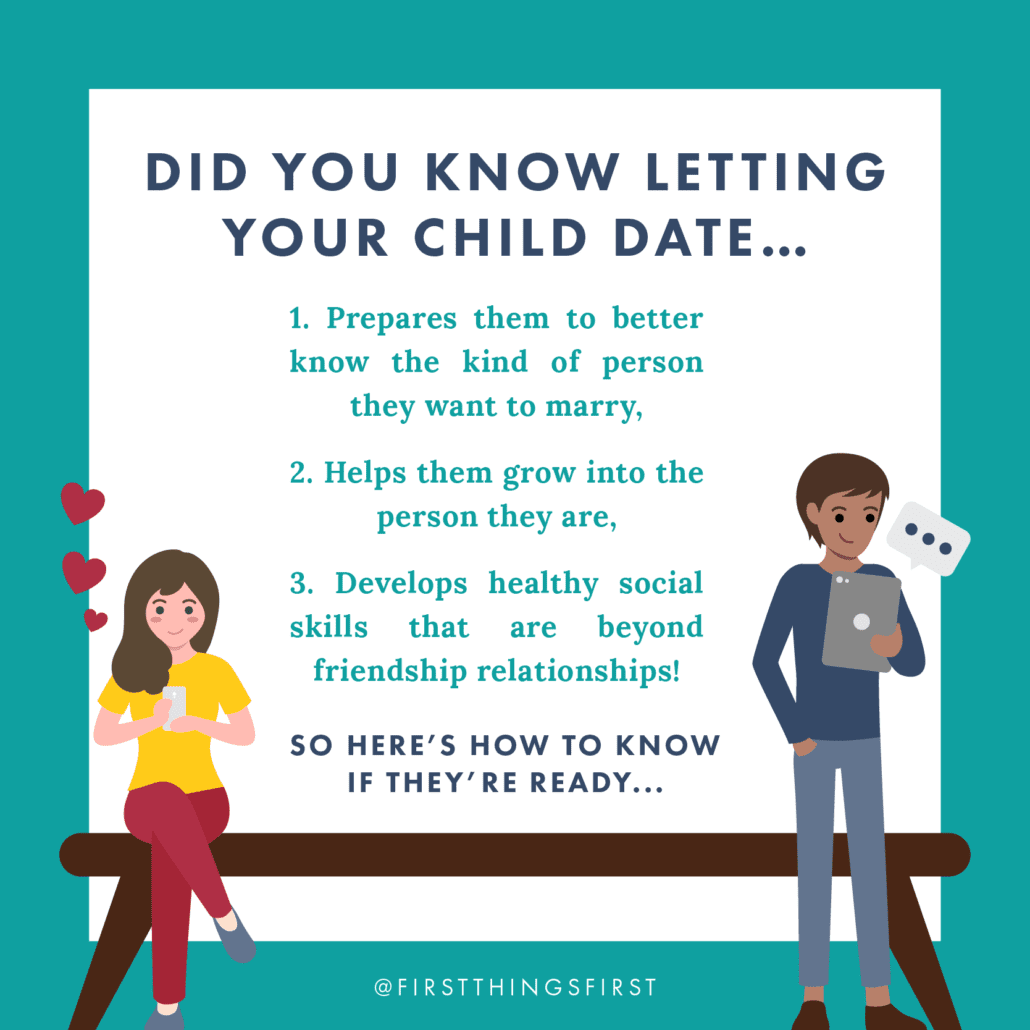
When they can’t yet articulate to me a good purpose for dating.
Let’s be honest—when my daughter walks out of the house to meet someone for a date, the first thing on her mind probably isn’t, okay, I’m doing this because… She just wants to have fun, talk to someone who is as interested in her as she is in them. However, before that day comes, I do want her to have in her head why, overall, she wants to date. Because at the end of the day, there are good reasons and bad reasons to date. I don’t know that there’s a single right answer for all families to the question, “What’s the purpose for dating?” Parents and teens need to talk together to determine some positive purposes, with parents being the voices of wisdom.
In our house, we talk about how dating:
- Prepares you to know better the kind of person you want to marry (if that’s something in the cards).
- Is something that helps a young person grow into the person they are.
- Develops healthy social skills that are beyond friendship relationships.
When they cannot yet grasp that their value doesn’t come from whether or who they date.
I want my girls to know that a romantic partner does not make them more of a person. They aren’t somehow “not enough” without a boyfriend. And that, despite what other people their age might be doing or saying, dating isn’t something you need to do because it helps you feel more accepted in your friend group. In other words, I want them to develop self-confidence and the beginnings of a firm identity beyond their dating life.
When a teen knows this, it can protect them from adolescent dating risks. Research tells us that teens who have a healthy amount of self-efficacy, or self-assurance, are less likely to experience dating violence, use drugs or alcohol on dates, or cave into sexual pressures.
If they don’t feel like they can communicate with me or their mom if something is wrong.
I’m just going to lay it out there for you: as much as it may pain you, when your kids begin dating, they will experience heartbreak, pressures, and temptation. They are going through the mental and emotional gymnastics of development. And they are going to come to points, many times, when they are stuck and need a voice of wisdom. That’s you. I want my daughters to know they can call me if they are at a place they don’t want to be and I’ll be there to get them. And I want them to feel comfortable to open up about what they are feeling or experiencing in a dating relationship. Despite popular belief, this is very possible.
If they are dealing with depression or anxiety.
The bad news is that, according to the National Institute of Mental Health, 30% of adolescents experience some kind of anxiety, and Pew research tells us that 13% of adolescents in 2017 experienced at least one major depressive episode. The good news is, the vast majority of these issues in teens are very treatable. If my daughters experience any kind of depression or anxiety, I’m confident we can work through it over time. However, I don’t want a boyfriend or an active dating life to be the coping mechanism they use to deal with these things. Bad things happen when the “other person” is made the emotional crutch.
When they can’t separate their dating life from their compassion for others.
What I mean here is sort of the reverse of the previous bullet point. Both of my daughters are very compassionate people; they’d gladly give everything they have to help someone who’s down and out. However, we’ve all seen relationships where one person stays because they feel the need to help the other deal with some issue. And this brings the fear that if you were to break it off, the other person might go off the deep end somehow. This is “martyr dating,” and it’s not healthy. I want my daughters to understand that dating is not the avenue to walk people through their problems.
A couple of caveats need to be made with the above points:
- Now, if I were to wait until my kids had all these things down in their development to let them date, well, they may be living in my house a verrrrrrry long time. Obviously, they won’t have it all together in their teen years. But the idea is to know my kids well enough to know that they are well on the road toward these developmental traits.
- These developmental lessons begin well before teens are anywhere close to dating age. As a matter of fact, they begin with a close, connected relationship between parent and child. Parents need to be in the pocket, having ongoing conversations on these ideas with their kids. This is how children build self-confidence and trust to go to their parents with problems, even when they are older. Ongoing conversations help teens cope with anxiety and other emotional issues. And it helps them come to a good understanding as to the purpose of dating.
There is no magic age a child should be allowed to date. It really depends on the child and where they are in their thinking and development. But one thing is for certain: parents need to become a student of their kids, continually learning more and more about how they’re thinking, what they’re feeling, and getting a sense of the direction of their development. This is the best way that we as parents can prepare our kids for a healthy dating life.
Image from Pexels.com
Should We Fight In Front Of The Kids?
Let’s be honest. We probably already do fight in front of the kids. Whatever you want to call them—“polite” disagreements, heated arguments, emotional debates, full-on shouting matches—we have them. We don’t necessarily plan to; they can just happen. A calm, respectful conversation can escalate quickly to savage verbal bloodsport. And guess who is taking it all in?
There is definitely a marital dimension to how you fight, over what, how often, and how you make up. But what about the parental dimension? What about that little person at the dinner table, or playing within earshot, hearing the brawl through the wall?
We have a large body of research on how “interparental conflict” or fighting affects kids.
Here’s what we know:
- Kindergartners whose parents had harsh and frequent fights were more likely to struggle with depression, anxiety, and behavior issues by the time they were in seventh grade.
- When parents are fighting, it’s physiologically traumatic for kids. Their blood pressure increases (even in very young babies).
- If you play audio of two adults fighting who are not the parents of a child, even that has a negative effect on the child.
- Depression, anxiety, rule-breaking, and aggression can be a behavior of a child who experiences their parents disagreeing regularly.
- Arguing in front of a child can be incredibly damaging to their psyche, as it creates a sense of instability and insecurity. This can manifest as guilt and a feeling of responsibility, leading to lifelong feelings of inadequacy.
- Parents tend to have their worst fights in front of their children.
- Family discord can actually alter children’s brains and make them process emotions differently. So, kids who witness their parents arguing a lot at home may struggle in social situations and have trouble making friends.
- Regardless of what parents are fighting about, children tend to blame themselves.
- The typical married couple has about eight “disputes” a day. Children witnessed their parents’ arguments about 45 percent of the time.
Here’s the thing: kids are smarter than we realize or think they are, and their development and intelligence begin at birth. Here’s the other thing: fighting, arguing, tension, instability, and volatility all have an effect on children whether we perceive it immediately or not. Here’s yet another thing: disagreeing, arguing, and even fighting are part of marriage.
★ So, how do we as parents mitigate the negative effects of fighting in front of the kids?
Story Time. Average American Family. (Mine.)
Sitting at the dinner table, son (6th grade) says he wants to try out for the school football team.
(Seemingly benign statement.) Not an uncommon thing to talk about at dinner. My wife immediately encourages him to try out. I counter with my uncertainty about football and brain health. (Still a civil conversation.) We go back and forth a bit. (Voices get a little louder and a little more intense.) My son is chiming in here and there. (It becomes clear that my wife and I are not on the same page on this.) She’s thinking I’m being overly cautious and robbing our son of fun and character-building. I’m thinking she is being cavalier with our son’s brain and there are other ways to have fun and build character. (This could quickly get personal. And ugly.)
What happens next is so important. And it is so simple. But our emotions usually have their way with us and innocent, common, organic conversations quickly escalate into harsh and harmful fighting that hurts our kids. My wife simply says, “Why don’t we discuss this later?” Me, “Dude, your mom and I will talk this through and let you know what we decide.” Conversation changes. Dinner is enjoyed. No harm done. Our son saw us disagree, have a debate, and stay on the same team.
Here’s what else we know:
- Parents who can resolve conflicts and emerge with warm feelings toward each other instill better coping skills and emotional security in children, studies show. This requires admirable self-control, and not all marital battles can be worked out so calmly.
- Marital battles that spark uncontrolled emotional outbursts should happen in private or in the presence of a therapist, and name-calling, threats, or other forms of aggression are never okay. But seeing Mom and Dad emerge from less hard-to-control disagreements satisfied, without resentment, can yield big rewards for children, according to researchers and experts in conflict resolution.
- Parents who expressed warmth and empathy toward each other during arguments also fostered a sense of security in their children that their families would be okay, according to a two-year study of 416 U.S. families.
- The research complements findings from a 2009 study by Dr. E. Mark Cummings that children whose parents have constructive conflicts, showing support and affection for each other, and exhibit better social skills, including cooperation and empathy for peers.
- Even if parents fight sometimes, a higher ratio of positive to negative exchanges is linked to less sadness and worry in children and teens, according to a recent five-year study of 809 families. Displays of warmth and mutual support helped offset children’s fears about parental discord.
It’s not whether parents fight, but how they fight in front of the kids that matters. And how they make up.
All conflict between parents is not harmful to children, but some conflicts may be very harmful for children to observe. Children may even benefit from observing constructive conflicts. However, destructive conflicts are linked to multiple problems in children and are stressful for them to hear or witness. Click HERE for how to fight in front of your kids.
***If you or someone you know is in an abusive relationship, contact the National Hotline for Domestic Abuse. At this link, you can access a private chat with someone who can help you 24/7. If you fear your computer or device is being monitored, call the hotline 24/7 at: 1−800−799−7233. For a clear understanding of what defines an abusive relationship, click here.***
“Why are you fighting?” That’s the question one little girl posed to her parents at the dinner table as they were in the midst of a heated discussion about what needed to happen after dinner. How do you talk with your children about why parents fight?
It’s pretty much a given that parents will get sideways with each other in front of the kids. Sometimes it’s about something ridiculous and other times it’s something of a more adult nature. Here’s the thing: whether it is something small or something that really matters, how you fight impacts your children. Children do not like conflict.
Witnessing your parents have an argument can be very scary and unsettling for children of any age. Here are some tips for talking with your children about why parents fight.
- Check your own emotional temperature. It’s very important to be emotionally-aware for yourself and for your child. Before you talk with your child about the reasons parents might fight, you’ll probably want to make sure you’re emotionally ready for it. For instance, right after a fight might not be the best time to have the discussion. When you take the time to cool down before approaching your child, you are practicing emotional regulation, which is a very important skill for both you and your child. When you talk with your child, be specific about the emotions they might be feeling right now. They could be experiencing fear, sadness or worry, among other things. Helping them to put names to what they are feeling will help build their emotional intelligence. It also helps them learn how to process through an experience.
- Keep it age appropriate. Everyone experiences conflict from time to time. Remind them about the time they didn’t want to share their toy with their sibling or when they were angry with one of you for not letting them do something. That’s a disagreement, too. Sometimes parents fight when they have different opinions about things, they are upset about something from work or they are tired, have a lot going on, or aren’t feeling well. Help them see that healthy disagreements are normal in families.
- Discuss feelings and tone of voice. There are times when parents argue that their tone of voice sounds mean, angry and loud. These moments can be very stressful for children. Literally, researchers have measured cortisol (the stress hormone) in children’s bodies and have found that even infants respond to their parents’ fighting. This could be a time when you apologize for the way you expressed your emotions and use it as a teachable moment to talk about how what we say and do when we are angry or upset with each other impacts everyone in the family. We all make mistakes. The goal is to learn how to do things differently the next time you have a disagreement.
- Reassure your child that you love them and that your desire is to work things out. If possible, let them see you resolve the issue together. If you are fighting about an ongoing issue that is creating significant angst in your marriage, be careful what you share with your children as you do not want to say things that are untrue or will paint your spouse in a bad light. You might tell them that you are asking for help to solve your problem if you cannot resolve it on your own.
Fighting scares children. As a parent, helping them to see that disagreements are part of being in a relationship and letting them know that just because parents are fighting, it doesn’t mean they are going to get divorced can help settle their anxiety. Teaching and modeling what healthy conflict looks like decreases drama in your home. It also prepares children for healthy relationships in the future.
***If you or someone you know is in an abusive relationship, contact the National Hotline for Domestic Abuse. At this link, you can access a private chat with someone who can help you 24/7. If you fear your computer or device is being monitored, call the hotline 24/7 at: 1−800−799−7233. For a clear understanding of what defines an abusive relationship, click here.***
7 FREE Things Every Family Should Do Before Summer Ends
Strengthen your bond with your sweet family by doing some or all of these 7 free things together before summer ends! No need to let these summer vacation days slip by without squeezing in some free fun for the family!
1. Be Explorers For The Day!
Soak in some sunshine and quality time with your family. Not sure where to start? AllTrails has 100,000+ trails listed all over with reviews and photos so you can find one perfect for your family. If you have some paper and a broken crayon laying around, bring it along to make an etch. Have your kiddo(s) pick out a tree or rock they think would have the wildest texture, then put the piece of paper on it and rub the crayon on top (preferably unwrapped and horizontally).
While you’re out adventuring in the great outdoors, answer these questions:
- What is your favorite part about exploring?
- What do you see that is interesting or fascinating to you?
- If you were going to bury treasure out here, where would you bury it?
2. Become Champions of the FTF Family Challenge!
This 30 Day Family Activity Challenge is packed full of fun for the whole family! If you love a good belly laugh, some friendly competition, or just some good ol’ quality time with the ones you love most, this is perfect for you. Of course, you may not finish it before the summer ends, but you can continue the challenge into the school year. You can download it for free and have some fun sitting in your back pocket. With a little help from the challenge, you keep your relationship with your family a priority as life picks back up. Be flexible with your schedule; you can do a challenge week or every other weekend.
After you all do a few activities together, ask:
- What activity has been your favorite so far and why?
- What’s your favorite part of family time?
- Have you learned anything new about yourself, like discovering you’re good at something you hadn’t tried before or perhaps that you don’t like something?
3. Picnic Together!
Simple, but always a favorite. Throw together a family meal and pick your favorite spot. Maybe for you it looks like driving to a local park, a lookout, or sitting in the yard. If it feels nice out, instead of dinner and a show, make it lunch and a game and bring along a family favorite board game to play when you’re done eating.
Conversation starters:
- What are three words you’d use to describe yourself?
- How do you know we love you?
- What’s your favorite thing to do as a family?
4. Be Expressionist Artists.
Now, I’m not talking oil canvas painting with classical music playing in the background—I’m talking expressionist like using a piece of paper and some sort of drawing/painting utensil to express yourself. Think of it like a picture journal.
You can use whatever is on hand—crayons, watercolors or even pens! You will be painting your thoughts about what these last few months have been like. If we’re honest, COVID-19 has changed the way daily life has been lived for the last few months. Putting those feelings into words can be hard for kids. Nonetheless, reflecting on what has happened is healthy and a great way to make sure you all are on the same page!
Sit down at the table or lay the art supplies out on the floor and paint/draw what the last few months has felt like. Here are some prompts: Draw/paint…
- How have you been spending your days?
- What feelings and emotions have you experienced?
- The hardest part of quarantine?
- The best part of quarantine?
- If your kids are a little older (8+) suggest drawing a comic strip to show their experience.
Once you all have finished, ask these questions:
- Tell me what’s going on in your picture?
- Why’d you choose to draw that?
- How are you feeling now?
5. Water Day!
Get ready to make a splash and go to the nearest body of water before summer ends. Whether it’s a creek, lake, ocean, river, pond, pool or hose in the yard, take advantage of it being hot outside and jump in!
You can do so many things with water!
- Swim.
- Build a dam with rocks at the creek.
- Play tag with the ocean by running as close to the waves as you can and then running back to shore without getting your ankles wet.
- Skip rocks.
- Feed ducks or fish with some stale bread or cereal.
- Splash contest! (Big or small.)
- Critter Count Contest. (See how many different critters you all can find!)
6. Movie Night!
Lights, Camera, Action! Take it up a notch and make a movie ticket for your kids and give it to them in the morning so they have something to look forward to all day. You can make it a “dine-in” movie and eat dinner while watching the movie. When it comes time for the movie, show your kids their seats, whether it be the couch, epic fort you encouraged them to make that day to watch the movie in or a pallet of pillows. Make it feel special. Presentation is everything. If you’re excited, they will be too!
Questions to ask after:
- What was the best part of the movie? Why?
- Would you have done anything differently than (insert main character’s name here)?
- What character do you think I am most like?
7. Silly Day Out.
Run errands or go to the park dressed up in costumes or goofy clothes. Take pictures and share laughs wherever you go. Teach your kids not to care what others think about them and to enjoy making the most out of the mundane things like grocery shopping. Not only is it a great lesson, but it will definitely be entertaining.
Questions to ask:
- What was the most fun part?
- Do you think other people were having as much fun as we are?
It’s good to be reminded that making some of the best memories cost nothing but time. Taking the time to enjoy being a family and having fun together is so important for the relationship you all have together. The more fun you have, the more you’ll love to be together.
✦ If you do any of these ideas, we would love to see! Tag us on Facebook and/or Instagram and have fun!
Bonus Blogs to Checkout:
What is your teen asking you about the future? Do you have answers?
“What am I gonna do about school and soccer, Dad?” my 14-year-old son asked me. I didn’t know. I’d been asking myself the same questions for weeks and didn’t have any answers. It feels like new information comes out every day that undermines my decisions. Everything feels tentative. The future feels like a collection of shreds and patches.
The last few months have left the foreseeable teen future uncertain. Your teen may be feeling a lot of anxiety: What will school look like? Will I be able to get a part-time job, play sports, play my favorite instrument in the band? What about prom and graduation?
And don’t forget their favorite part of school—seeing their friends. There’s so much unknown for them to process.
Don’t forget, they are old enough to wonder about your adult future and the family’s future. You may feel secure about your job situation, your finances, the health of family members—and something like divorce may be totally out of the question. This doesn’t stop your teen from worrying about those things.
All of these unknowns can easily translate into anxiety, stress, and depression for your teenager. (They can for us adults, too.)
When it comes to the important things in life, we all prefer certainty to uncertainty. But our adult brains are developmentally better suited to live with some uncertainty than our teen’s brain is. Their brain is still developing and processing so many unknowns (that they are invested in) can be particularly difficult for them. How can we help them?
[Read this blog that describes what is happening to teens developmentally.]
1. Model The Behaviors And Attitudes You Want For Your Teen
- Self-Care: Tending to your physical health and emotional health.
- Mindfulness: Deep breaths. Self-awareness. Focus.
- Critical Thinking: Decisions based on the most reliable information.
- Optimism: “We are going to come out on the other side even stronger.”
- Resilience: “We are going to take it one day at a time as a family.”
- Gratitude: “We still have a lot to be thankful for…”
- Service: “How can we help others who are struggling?”
These are all things that your young adult needs to navigate uncertainties they will encounter as future adults.
2. Acknowledge When The Future Is Unknown & When You Just Don’t Know
We want to have answers for our teens and they often expect us to have them. It can be tempting to try to “fake it” or give the answer we think will make them feel better in the moment. Besides being disingenuous, in the long run, it will undermine their confidence in you. You don’t want to be seen as a source of false hope and misinformation.
It is totally appropriate (and honest) to admit it when we don’t know. Saying something like, “I don’t have enough information yet to confidently make a wise decision about that,” doesn’t undermine your trustworthiness and reliability; It enhances it. Your teen can relax (hopefully) and know that when you do make a decision it will be based on the best information and what’s best for the family.
3. Become A Student Of Your Teen
Be on the lookout for the ways your teen might be struggling with anxiety and stress and depression. A very talkative teen may become quiet. A very quiet teen might become talkative. A normally social teen may become withdrawn. A teen that normally keeps to themselves might suddenly become a social butterfly. Look for any changes in their normal behavior.
Keep in mind that sometimes teens deal with difficult emotions in unhealthy ways. Be on the lookout for outbursts, disrespect, risky, or harmful behavior. Watch their eating and sleeping habits. As you address their behavior, be sure to address what the real issue may be underneath it.
4. Be Open And Create Space For Your Teen To Express Their Anxiety
Teens will often “show” you when they are struggling before they will “tell” you they are struggling, but there are things you can do to keep the lines of communication open:
- Make sure your teen knows you have an “open door” policy and that they can talk to you about anything, anytime.
- Take advantage of car rides and other times you are alone with your teen that don’t feel like you are angling for a “big talk.” Teens often open up when you are doing something else, like cooking or watching television.
- It’s okay to ask questions like, “How are you feeling about school this year?” Then practice active listening skills.
- Don’t “freak out” at what you hear. Keep that poker face.
- Don’t ask a million questions, probe gently, empathize, and be a good listener.
5. Recognize When You Are Out Of Your Depth And Get Your Teen Help
Anxiety, stress, depression, and anger are significant and often complex problems—especially in the lives of teens. It is totally appropriate and necessary for you as a parent to recognize when you have reached the limits of how you can help your teen. Don’t stop there. Reach out for help. Contact a counselor.
The unknown is, well, unknown. It is normal to experience fear and anxiety concerning the unknown. There are lots of things that your teen cares deeply about that are just flat out up in the air at the moment. Don’t feel bad that you can’t make the unknown “knowable” for your teen. Model how to face the unknown, be there for your teen, and keep putting one foot in front of the other until the unknown becomes known.
It started with a simple question from my son at the dinner table. “Can I invite a few friends to go to Six Flags Amusement Park with me for my birthday?” Would it end up as a fight in front of the kids?
Mom: That should be fun. How many friends are you thinking about?
Son: Two.
Mom: Sounds like a good idea.
Dad (Me): Hmmm. I’m not so sure that’s a good idea right now.
Mom: Really. Why not?
Dad: Have you looked at the cost for one person to go to Six Flags? Let alone 3 or 4. Have you looked at our bank account lately?
Mom: How many times does our son turn 10 years old?
At this point, we had a decision to make…
- Do we continue this disagreement that was morphing into an argument in front of our kids?
- Should we squash the conversation until we could get behind closed doors?
We both were starting to recognize that we felt strongly about our opinions. Internally, we were questioning the next step of the discussion and asking,”Should we have this fight in front of the kids?”
I’m going to jump in with how we fight, or put another way, resolve disagreements and conflict in front of our children, if that’s where you find yourself. It is inevitable that you and your spouse will have a disagreement in front of your kids. How you handle these disagreements can have a great impact on them.
If you choose to work through conflict with your spouse in front of your kids, here are a few tips:
1. Respect, Respect, Respect.
- There is never a time when it’s okay to disrespect one another’s thoughts, feelings or desires regardless of how emotional you get or how strongly you feel about a particular issue.
- It’s even worse to disrespect one another in front of your children.
- We disrespect when we belittle one another’s thoughts, are dismissive of each other’s emotions and devalue each other’s desires.
- Respecting one another is more important than coming to the “right” solution.
- Dr. Adam Grant, a psychologist at the Wharton School and New York Times best-selling author states that, “When parents disagree thoughtfully and respectfully, that sets a standard for kids to learn to do the same thing.”
- Your children are learning how to treat other people they disagree with based on what you show them.
If you realize you have disrespected your spouse, it’s important that you not only apologize to your spouse, but that you also talk with your children about it. They must understand that disrespect is not acceptable.
2. “I,” not “You.”
I could’ve said to my wife, “You don’t know how much money is in the bank.” But I could have also said, “You care more about him having fun than about us being responsible.” In that instance, I’ve attacked her and assumed what she knows or cares about. Dr. John Gottman, marriage therapist and researcher says, “When you start sentences with ‘I’ you are less likely to seem (or be!) critical, immediately putting your partner into a defensive position.” Instead of starting with “You,” I can say, “I’m concerned that paying for this trip may not leave us enough money for other necessary and important things.”
☆ Focusing on what you know, think, feel, and want as opposed to making statements about what you believe your spouse knows, thinks, feels, and wants leads to better communication and understanding during conflict.
3. Avoid statements like, “You always,” or, “You never.”
Statements like this make generalizations about a person’s character, placing the focus on them and putting them on the defensive while taking the focus away from the issue.
4. Tone of Voice and Body Language Matter… a lot.
I encourage you to stop and watch kids talk and interact sometime. Many talk with their hands, give colorful facial expressions, their tone gets high when they’re excited and loud when they’re upset. This is the lens through which your child sees your body language and hears your tone of voice. Not to mention that research says 93% of communication is made with body language and tone of voice and only 7% are the actual spoken words. Avoid eye-rolling, sighing heavily like you’re disgusted, slumping your posture like you don’t care or rolling your neck like you have a bad attitude. Your children are reading each of the cues you’re sending.
5. Be clear to your children when it’s resolved.
Your child is processing what they see and hear. If they hear the conflict and are never privy to the solution, then you’ve left their imagination to wonder. Research by Dr. Rebecca Brock, assistant professor at University of Nebraska, indicates that unresolved marital tension can lead to children experiencing anxiety, depression, and distress.
This may cause children to feel extremely insecure.
If your child sees the two of you arguing, be sure they know and see that you’ve resolved the issue. Even if it’s just to say, “I know you heard us arguing earlier. I just want you to know that we figured it out and everything is good now.” The details of the solution may not be necessary to share. But the acknowledgment that the argument is not going to tear you apart helps bring closure for the child.
How Not To Fight
- Never attack one another physically or emotionally. That’s domestic violence.
- Don’t manipulate, intimidate, or threaten your spouse. Threatening to walk out, leave the marriage, or do something that is hurtful or permanent can leave scars that wound for years.
- Never put the kids in the middle of your argument. They should not be choosing sides or used as a pawn to help you win your argument.
What Not To Fight About In Front Of The Kids
There are some things that are simply a bad idea to argue about in front of the kids.
- Sex
- In-laws
- Discipline
If you’re going to fight in front of the kids, then you should definitely make up in front of the kids. (No, not that kind of “make up.” Shame on you! 😳 ) A hug and a kiss in front of the kids is plenty. Verbally affirming your love, respect, and commitment for one another also sends the message that your commitment to one another is bigger than the disagreement. Arguing in front of your children can be damaging to them, especially when it’s not done in a healthy and productive manner.
Model Healthy Conflict Resolution.
Studies show that your children can learn healthy conflict resolution skills when you model it for them. How you treat one another, including when you disagree, provides an example for how a couple communicates respect and acceptance. You’re also modeling how to effectively deal with your emotions and appreciate others emotions. These are all skills that will definitely be useful as your child engages in relationships throughout their life.
My son did get to go to Six Flags. After listening to me and his mother talk about our thoughts and feelings regarding the gift and adding up the cost, he had a greater appreciation for his gift. Did he know that I was not the one in support of the trip? Maybe, but I don’t think it bothered him as he, I, and his other friend rode the roller coasters. He also learned that his parents can disagree, both have strong opinions, and still love, respect, and remain committed to one another.
★ What do you want your kids to learn when they see you fight?
***If you or someone you know is in an abusive relationship, contact the National Hotline for Domestic Abuse. At this link, you can access a private chat with someone who can help you 24/7. If you fear your computer or device is being monitored, call the hotline 24/7 at: 1−800−799−7233. For a clear understanding of what defines an abusive relationship, click here.***
How to Parent an Extremely Sensitive Child
If you’re the parent of a young child or toddler, you know the joys (and consequently devastation) of a helium balloon. My 4-year-old, Jackie, held tightly to the string of a balloon that had been floating around the house, left over from a surprise “just because” package from work. Her face lit up with pure delight as she ran around the house with it. I warned her not to let go of the string, because if she did, it would float to the top of the high ceilings in the living room, making it unreachable. She dismissed me with a “Yeah, yeah mom,” as kids do, and continued to play as I made lunch in the kitchen.
One minute later, there was a terrible shriek. Bone-chilling. And the weeping and wailing began. Jackie had accidentally let go of the balloon and, sure enough, it had floated up to the high ceiling, out of reach. And now the world was ending. (TBH, I may or may not have rolled my eyes.) As I stopped preparing food and prepared to go comfort Jackie, I heard her younger 2-year-old sister, Maddie, attempt to comfort her. “I’m here! I’m sorry, sissy! I’m sorry!”
Jackie’s response through screams and sobs? “No Maddie, it’s not your fault. You don’t need to apologize. THE BALLOON NEEDS TO APOLOGIZE!”
If you’re the parent of a young child or toddler, this scenario seems pretty typical, right? But what do you do when this is a daily occurrence? Or even multiple daily occurrences? What if your child cries easily and often? They have multiple meltdowns a day because they are so highly sensitive. How do you handle the crying, outbursts and tantrums and still discipline a sensitive child, without crushing their spirit?
Recognize That Emotions Are OKAY.
Many of us were taught at a young age to suppress our emotions, whether it was our parents’ intentions or not. Telling a child, “You’re fine… don’t cry…” when they’re upset minimizes their feelings. Instead of building a connection and safe space for them to process through, it actually tells them that their emotions make you feel uncomfortable, angry or annoyed and can slowly chip away at the sense of security they feel with you. We are often triggered by our children’s behavior, taking us back to how we were parented. So be intentional about allowing their big emotions and responding with connection instead of reacting as if they are wrong. Make space for them to feel, no matter if you see their emotions as logical or ludicrous. Try switching up, “You’re fine… don’t cry…” to “I can tell you are feeling ____. It’s okay to feel that way. I’m here.”
Help Them Learn Emotional Intelligence.
ABCs and 123s are great for our children to learn, but what about emotional intelligence? Children are not born knowing how to regulate their own emotions. It’s absolutely a skill that needs to be taught! So help your child learn to recognize what they are feeling by giving them the vocabulary of emotions. Talk about your own feelings, read books about naming and dealing with emotions, and above all, be there for them without judgment of their emotions. Then, help them find effective calming strategies like: Count to 10, Take Deep Breaths, Read a Book, etc. Often if your child is acting out, or “misbehaving,” it is most likely due to an underlying unmet need like being hungry, tired, or feeling disconnected. Grabbing a snack solves 97% of our household meltdowns. (Because yes, kids get HANGRY, just like Mama!)
Practice A WHOLE LOTTA Patience With Your “Orchid Child.”
Human development specialists W. Thomas Boyce and Bruce J. Ellis explained the opposite ends of the human temperament continuum using two Swedish words, Orkidebarn, which translates to “Orchid Child” and Maskrosbarn, which translates to “Dandelion Child.” Where Dandelions are known for surviving the most challenging circumstances and still thriving, Orchids require “just right” conditions to flourish and grow. Children who show more of an “Orchid child” temperament are just the same. They need more time, patience and help at learning to self-regulate their emotions. So hang in there! Be the calm in their chaos, and show empathy and compassion for their big feelings. It’ll take time, but they will learn how to process through their emotions more quickly and effectively as they mature.
Have Confidence In Disciplining Without Damage.
For many parents, the term discipline has been confused with punishment. We want to discipline (aka teach) our children in order to prepare them for the real world. However, neuroscience shows us that children’s brains are naturally impulsive and lack the self-control of adults. Many times children simply cannot (as opposed to will not) follow through with our demands because their brain doesn’t yet have a fully-developed frontal and prefrontal cortex, both of which are crucial to regulating self-control. However, parents often try to force their children to learn to obey through consequences, time outs and other methods that serve to control the behavior. And these types of discipline can absolutely get our children to conform, but that may not necessarily teach them what they truly need to be successful in life: self-control.
In order to teach self-control to our sensitive child, we need to:
- First focus on responding with connection. Get down on their level, or try to make eye contact with them. Acknowledge, name, empathize and validate the emotion they are feeling. For example: “I can see you are upset because you don’t want to stop playing. That is very difficult. I understand.”
- Then, stay calm and caring while still maintaining control of the situation. Avoid raising your voice, pointing fingers or threats. Make space for them to feel angry, upset, frustrated, sad, etc., without trying to “fix it.”
- Next, provide a simple directive on what needs to happen. The fewer words you use the better. An example may be: “It’s time to leave,” or “We are leaving now.”
- Then, firmly hold the limit you’ve set. Avoid trying to explain your reasoning or rationale at this moment. For instance, don’t say, “We have to leave right now or we’ll be late and then we’ll miss the whole appointment! Hurry up!”
- Finally, once the emotion has been regulated (through the help of naming the emotion and working through it using calming strategies), we can come back full circle to discuss step-by-step what happened, without blame or shame, and provide ways to handle a similar situation better next time. (Ask your child what they could do differently next time. If they aren’t sure, provide some options such as using a specific calming strategy and talking about what they are feeling. Be sure to end the conversation with encouragement for next time and remind them that you love them, no matter what!)
★Bottom Line: You’re NOT Doing It Wrong… It’s Just That Hard
No one has this parenting thing down to a “T.” You know, there’s no such thing as a perfect parent. A sensitive child can be extremely draining… but rest assured, you are not alone. Connection is the key to handling a highly sensitive child, or any child for that matter. You’ll just need to cultivate a bit more patience with your Orchid child. Helping your sensitive child learn how to self-regulate their big feelings will take longer, since their brain needs to be more developed (i.e., older). But give it time and you will see tremendous growth! Meanwhile, keep those tissues handy.