
How to Find Good Relationship Advice
You want to have good relationships. You want a healthy marriage AND you want to be a great parent, a wonderful friend, fiancé, or co-worker.
But relationships are sometimes complex. They aren’t always easy. Issues arise. And if you’re like me, you could just use some help sometimes.
The internet gives us ENDLESS information on relationships. Just Google how to resolve conflict in marriage or how to parent a rebellious teenager. Then watch TONS of articles, blogs, videos, how-tos, and step-by-steps fill your screen.
It’s overwhelming.
And here’s the thing: can they all possibly be right? I mean, with literally thousands of resources out there on any given relationship subject, there’s got to be some conflicting information and something that’s not accurate. (As a matter of fact, there is.)
★ So when you and I are trying to get help in the area of healthy relationships, how do we know what kind of information to trust? How do you wade through the countless sources of information on your screen and determine which advice is legit?
I’ve been on both ends of this spectrum, searching for accurate relationship advice as well as writing relationship content as accurately as possible. And I can tell you there is a lot of good information out there, as well as a lot of bad.
Here are some pointers I’ve found helpful on how to identify reliable relationship advice.
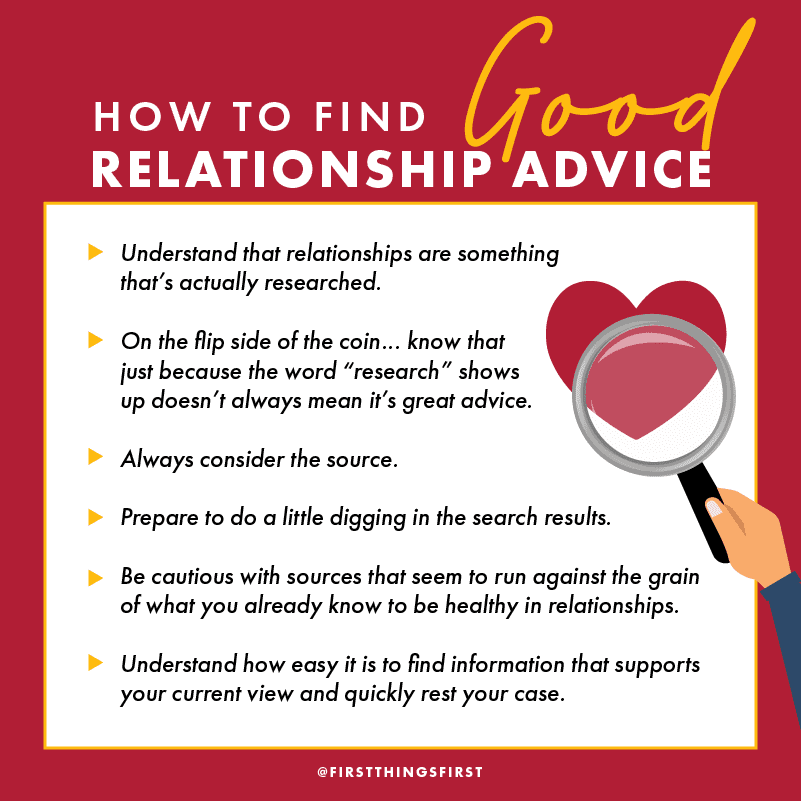
Understand that relationships are something that’s actually researched.
Seriously, there’s a whole science behind it. There are a lot of experts and researchers out there looking at questions like what makes a marriage great, what kids need from their parents, what are the best ways to resolve disagreements, what role does intimacy play in relationships, etc. And, they’re observing and testing answers using psychological research techniques.
This is good to know because it tells us that there is, indeed, reliable information out there to tap into for our relationship questions and struggles. Good sources of information are typically (but not always) written by researchers who have either done the science themselves or by professionals who have used the science to counsel others. That’s usually what I want to look for when it comes to good relationship advice.
On the flip side of the coin… know that just because the word “research” shows up doesn’t always mean it’s great advice.
I’ve read countless articles using the words research says… or studies prove… or a survey of 500 people tells us… If you search for any kind of advice about relationships, you’ll find this, too. And it sounds very convincing.
But for many reasons, it doesn’t always mean you can trust the advice. For one thing, it’s easy for writers to twist the words of a piece of research out of context to fit their own point of view. Not to mention, a lot of research just plain isn’t done well. You don’t have to be any kind of research expert to take what you read or watch with a grain of salt or even sense there could be some missing information.
I’m not saying count these kinds of articles out. Give them a chance. Just approach them with a more critical eye. And here’s something I’ve found: if you come across an article that says some sort of research proves something, approach with caution. Researchers don’t try to prove anything. The goal of the research is to provide evidence of one thing or another and spark people to study the question even more. Claiming proof for something could be a big red flag that the writer could be twisting some facts.
All this goes to say, of course, to consider the source.
With any article or video, take a quick look at the author’s bio. Google them. Do they have a background in relationship research, education, or counseling? Are they associated with a university or an organization specializing in relationships like marriage or parenting? Do they have a product to promote? Does their writing seem to have an agenda? Does it sound like they have a chip on their shoulder (like they’re ready to pick a fight)? Or, are they simply trying to report the best information out there as objectively as possible? These are all important questions to consider.
Do a quick search on “reviews” or “criticism” of the author or the organization they represent. See what other people are saying about them.
I particularly like authors who are transparent about their own relationships and balance it with trustworthy fact-giving. Rather than making bold claims saying what they are doing in their own relationships is the way to go, thank you very much, they tend to admit where they’ve messed up before and humbly say let’s look at evidence of what’s healthy.
Prepare to do a little digging.
I’m confident telling you it’d be a mistake to only consider the first few pieces of relationship advice at the top of your search list. Sometimes these are reliable resources, but not always. The first sites popping up on a search list many times are determined by popularity factors or advertising dollars. This means you could very well be getting relationship advice based on opinions instead of qualified research, and on the fads families of “the rich and the famous” are doing. (This is just my two cents: it’s difficult for me to swallow trying to relate to Hollywood trends in marriage and parenting. I’m not dissing actors or performers; it’s just a totally different world from the norm, and it rarely reflects what we know to be healthy in relationships.)
Dig down below the first few search results and see what else lies beneath. This is often where you’ll find the real gold of reliable relationship advice.
Be cautious with sources that seem to run against the grain of what we already know to be healthy in relationships.
I get a little twitchy when I see titles like The Way We’ve Been Doing Marriage for Decades Is All Wrong! I don’t ignore those sources completely (Who knows?—they might have some good info after all…), but I do tend to read or watch it with a lot more discernment and savvy. Apply what’s been said above to these kinds of articles and determine for yourself if the information given is truly on the level.
Understand how easy it is to find information that supports your current view and quickly rest your case.
These days you can just about find anything that will claim to back up even the wildest of ideas on how to do healthy relationships. (“Survey Proves a Steady Diet of Tacos Will Improve Your Marriage” — I knew it!)
So if you’re simply trying to find something to support the opinion you already have, then guess what? You’re going to find it.
When approaching a piece of relationship advice that may run counter to your viewpoint, I find it helpful to give the information a chance. I’ll often think to myself, “Could there be the possibility that this differing opinion (other than mine) might have some truth to it?” And then, based on all the things I’ve talked about above plus a dose of common sense, I determine if the advice is worth taking.
If you truly want to learn what healthy marriages, parenting, friendships, dating, and work relationships look like, good information is out there for you to get your hands on. But it’s like swimming in the middle of the ocean. There is a virtual sea of information to swim through. Much of the advice is like currents which will guide you safely to the shore of healthy relationships. But there are some riptides of bad information that can drag you further out to sea.
One more thought to leave you with: finding relationship experts online can be extremely helpful.
But let’s not look past the fact that you probably have actual people around you in healthy (but not perfect) relationships who you can lean on. A get-together over coffee where you can ask this person (or couple) questions about how they do things in their relationships can provide some very practical wisdom.
Put the above ideas into practice, lean on the healthy people you know, and I guarantee you’ll learn more about what makes relationships healthy than you ever thought you could have.
***If you or someone you know is in an abusive relationship, contact the National Hotline for Domestic Abuse. At this link, you can access a private chat with someone who can help you 24/7. If you fear that someone is monitoring your computer or device, call the hotline 24/7 at: 1−800−799−7233. For a clear understanding of what defines an abusive relationship, click here.***
What to Do if Your Teen is Sexting
(Part 2) – Check out Part 1, How to Talk to Your Teen About Sexting
In part one, we talked about giving your child a smartphone and what they need to know about sexting to protect themselves. Now, regardless of how you found out, you know your teenage son or daughter is sexting. Step #1, get a hold of your own emotions – embarrassment, guilt, disappointment, shock, anger – so you can have a productive conversation with your teen. If you need to go for a walk, phone a friend, talk to your spouse – whatever. It’s completely okay to tell your teen, “We’ll discuss this tomorrow.” It’s not only okay, but it is also very wise. You have thoughts to get together.
Thought #1: What do I want to accomplish with this conversation – for my teen and for myself as a parent? Don’t rush thinking this through. Have goals.
Thought #2: This isn’t going to be a one-time talk. You want to open the door for an ongoing conversation about sexting and other difficult teen conversations – pornography, sex, drugs, alcohol, dating violence, etc. You want to be an empathetic, askable parent so your teen feels comfortable talking to you about anything.
Thought #3: Try to find a time and place that allows for private undistracted, uninterrupted conversation.
[Here’s an example of a real conversation about pornography. Notice the parent doesn’t lecture, doesn’t ask a million questions, doesn’t guilt-trip their child. The parent clearly doesn’t condone pornography but is more interested in finding out their teen’s thoughts, ideas, and beliefs. This doesn’t mean there will be no consequences. But the parent is trying to build a relationship to keep these kinds of talks going.]
Step 1
In a calm, direct voice, ask your teen about the circumstances around the sexting. Then wait and really listen to them without judgmental facial expressions or tones. Keep your mind and your body language open. You can disapprove of what your teen did but still be deeply concerned about them, validate their feelings, and the fallout of their choices.
✦A word about punishments for sexting. The normal, obvious go-to is to take their phone away. Maybe you need to in their situation. This might be their 5th offense. They may not be ready for the responsibility that comes with a smartphone. Maybe they need an off-the-shelf phone that just allows them to talk and text.
I don’t usually dabble in how parents punish their kids. Every kid and every family is different. I will say this: I’m a big fan of letting the universe handle some of the disciplining of my kids. I’m referring to natural and logical consequences. Sometimes the punishment is built into the poor choice. The choice to sext often has some built-in consequences like guilt, humiliation, a destroyed reputation, being bullied online and in real life, getting in trouble at school, the law getting involved, and on and on. You know your child better than anyone. How are they navigating these consequences? Do you need to drop the hammer on them or help them up? We’ve all done something we regretted. Making mistakes is a normal part of growing up. The important thing is to learn from it.✦
Step 2
Ask questions to dig just a little. NOTE: This is different than an interrogation. As you have a conversation, try to work in some of these questions.
- What do you get out of sexting? How does it make you feel?
- Did you feel pressured to do it?
- Did the recipient promise not to show anyone?
- What is considered “normal” about sexting among your peers?
- Have you received sexts? What did you do with them?
- Are there things on your phone you wouldn’t want me to see?
- What has been the fallout of your sexting?
- Do you think sexting is wrong? Why or why not?
Resist the urge to lecture or ask a million follow-up questions. Act comfortable and be direct. Show you’re really listening and trying to understand your teen and let them feel heard. You may not get to all this in one conversation. That’s okay. Know when to stop the conversation. You can always pick it back up. Let your teen know you love them no matter what.
Step 3
There are some things your teen needs to know about sexting. (They will roll their eyes. Ignore it.) You have a responsibility as a parent to make sure they know and understand certain things. So what are you supposed to do, whether you think your teen is sexting already or whether you’re worried they might start in the future? Believe it or not, you’re not powerless. So what can you do? Sheknows.com breaks it down.
- Talk to your teen. A scary thought for many of us, but one of those unavoidable responsibilities of parenting. Talk to them about the possible long-term consequences of getting involved in sexting. Like the fact that nude images of kids under age 18 are child pornography, which is illegal. Talk about the short-term consequences, like the whole school getting a hold of a “private” photo shared with a former boyfriend or girlfriend. Talk about self-esteem and self-respect. Consider how you might be setting yourself up for a lot of drama.
- Set rules. Do you let your kids drive drunk? Do you let them ride in the car with no seat belts? So why give them something as dangerous as a cell phone and not establish rules? Start random phone checks, and go through everything on it regularly.
- Take away the cell phone. Drastic, yes. But sometimes necessary when nothing else is working. If you truly don’t trust your child, why would you trust them with a tool they can use to bully others?
Resources:
Common Sense Media: Sexting Handbook
Amanda Todd YouTube Video (Some might find content disturbing.)
6 Things Every Teen Needs to Know About Sexting
Why Is Sexting a Problem for Teens?
The Consequences of Sexting for Teens
If you or a loved one are having suicidal thoughts, contact the National Suicide Prevention Lifeline at 988 or 1-800-273-8255 for support and assistance from a trained counselor. If you or a loved one are in immediate danger, call 911.
Mom, Here are 5 Ways to Process Being Called a “Superhero” When You Don’t Feel Like One
My sons and I were in a large department store together. The boys were 9, 4, and 1 at the time. While we were in the car, I restated the “how to act in public” rules:
Don’t look at anything, ask for anything, or touch anything!
I get them into the store. The little one is sitting in the front of the buggy, the 4-year-old is sitting in the buggy, and the oldest is walking beside me. An older lady approached us and said: “OH, you have such handsome and well-behaved sons.” She continued, “I only had one child and felt like I was losing it most of the time. Now, I see you with three boys. Wow, you are like a superhero MOM!” I felt like a fraud.
Superhero Mom? What is that?
If she only knew what I said to my kids in the car before entering the store and my tone of voice. OMG! Does she truly think that about ME? Nope, it is not true: I haven’t washed clothes in a week. My house looks a mess. There is no way that I’m a superhero mom. One part of me knows I don’t have to live up to that, but the other part of me says I do.
To me, superheroes are perfect. If you’ve been a mom longer than one day, perfection seems like an unattainable goal. Some days as a mom, all you can do is get out of bed and place one foot in front of the other. You do not feel super or like a hero. You often feel insignificant, overwhelmed, agitated, frustrated, sad, and forgetful because the expectations you have for yourself are already unrealistic.
How do you reconcile your feelings about your parenting with what others say?
Accept the “superhero” compliment as a compliment (nothing more, nothing less).
Moms tend to be so hard on themselves. You want your child to be successful, happy, and well-adjusted. Instead of accepting what is meant to be a compliment, you can only think of reasons why this can’t be or isn’t true. Or in your mind, other moms seem to do it better, faster, and easier than you (at least that’s what it looks like on IG). It’s okay even when you don’t feel worthy to just say ‘THANK YOU.”
Understand the compliment.
Often, the people closest to you see things in you that you don’t see in yourself. Your family and friends see how you: work hard, love your family and friends well, and volunteer in the community. They see your strength, resilience, caring, and compassion in the midst of difficulties. But they also see your struggle yet want to encourage you through it. They want you to know that you are seen and valued for all you do. Their intention is not to add pressure, but to acknowledge all of your efforts.
Note for the compliment-giver: It’s also important to recognize what moms “hear” when they are called a superhero. When those words are spoken, many women, because they don’t feel like they are “momming” well, take the words on as added pressure that they need to live up to the title. Maybe instead of calling her a superhero mom, it would help if we actually called out the characteristics we believe make her a superhero—patience with the children, I love the way you engage with your children, your home has a warmth that is comforting, I appreciate the way you keep things in perspective—your children are small for such a short amount of time; the dirty clothes and dishes will always be there.
You do you.
It’s so easy to look to your left and right to see what and how other moms “mom” and judge yourself as lacking. It’s essential you recognize that being yourself is enough. Life isn’t about comparing yourself to others. They’re not you. They don’t have your family. You know what’s best for your family, whether it’s related to technology use or diet. It may be difficult to block out the questions or opinions of others, but it’s imperative you do.
Be realistic in your expectations.
It’s important to realize that “you can have it all, just not at the same time.” Take some time to think about and prioritize what’s important to you about your family. Once you have clarity on what matters the most to you and your family, let the other things go, including the guilt of not being everything to everyone. Recognizing what you can and cannot control goes a long way toward reducing stress and unrealistic expectations.
Stop minimizing your attributes.
As moms, we’re really good givers of compliments and time to others, but not good takers when others want to give us compliments and time. Not everyone has the same abilities. Just because something is easy for you, it doesn’t make it easy for everyone. When someone gives you a compliment about something you do, stop internally negating it. Just say, “Thank you.” You may feel like you’re being dishonest because if they only knew… If they only knew the number of shortcomings, flaws, mishaps I have on a regular basis… Guess what? So does everyone else! None of us are perfect, no matter how our social media pages look.
It’s not easy being a parent. You feel bombarded with information and messages that seem to make parenting even harder. You feel the pressure, all the time. Give yourself a break; all parents have moments of joy and of struggle. Enjoy all the moments you have with your family. Graciously accept recognition, even when you feel like you don’t deserve it or didn’t do anything special. You are special and exactly who your family needs.
6 Fun Ways to Strengthen Your Relationship with Your Toddler
That little ball of energy you call your toddler is so cute when they’re little. The mess on their face after eating spaghetti is adorable. The way they want to cuddle with you right after you’ve disciplined them just melts your heart. During these early years, you can lay a firm foundation for having a strong relationship with your child for years to come. Here are just a few fun and easy things you can do to help your child feel safe, happy, and secure with you—the love of their life.
1. Shower With Love.
Sounds like it could be exhausting. It’s not. My 2-year-old loves to stand on my feet as we walk from his room to the dinner table. My 4-year-old loves for me to blow real loud kisses on his cheek. Harvard researcher and founder of The Basics, Ronald Ferguson says the simplest way to show love to your child is through simple acts of affection. Be free and fun with your affection toward both your boys and your girls. Sing to your child in your loudest, most out-of-tune voice declaring your love for her. They’ll know you not only love them, but you like them. After all, it’s difficult to have a strong relationship with someone who you’re not sure likes you.
2. Play, Play, Play.
You don’t have to play all day. Stephanie M. Wagner, Ph.D., Clinical Assistant Professor in the NYU Department of Child and Adolescent Psychiatry suggests, “Spending a few minutes in a special time playing with your young child will help both of you feel good about each other.” Regularly spending some time in free, exciting, adventurous play can do the trick. They’re toddlers, so keep it simple. Throw, roll, or kick soft balls. Build stuff using blocks, couch cushions, boxes, or whatever’s handy. Pull out the washable paint and use paintbrushes or just use your hands to create a masterpiece. Play hide and seek. You’re showing them that having fun is a good thing. You’re satisfying their curiosity and you’re helping them to associate laughter, smiles, and fun with the parent/child relationship.
3. Make Adventures Through Stories.
Reading and telling stories creates bonds and builds imagination. When storytelling with your toddler, sometimes use books with words, other times, pictures are plenty. Use your imagination to tell a story based on the pictures. And other times, no book is needed, sit them on your lap and make up a story. Have them guess what’s going to happen next. The places you’ll go together on the imagination train will have the two of you seated together on memory lane forever. It’s a great way to end the day or make dinner time with your toddler fly by.
4. Create Family Traditions.
A tradition can simply be something your family does regularly. Taco Tuesdays. Friday night movie night. Saturday morning crazy breakfast. I mean fun time. Sunday trip to Grandma’s. October pumpkin patch visits. First day of summer water bash. Children like the consistency and predictability parents and traditions provide. Traditions will help your child feel a sense of belonging to the family unit as they look forward to the various customs you observe in your home. The holidays are good for traditions. However, the most memorable traditions are often ones you create as a family.
5. Make Music. Dance To The Music.
Children love to sing and for you to sing to them. ABCs. Nursery Rhymes. Age-appropriate songs on your playlist. And of course, songs you make up. Sing and dance in the bathtub, in the kitchen, while getting dressed, doing their hair, and while driving them around town. Eventually, you’ll hear your child singing after you lay them down to sleep, while they’re playing with toys, and funny enough, while they are handling their business in the bathroom. They’ll be using those vocal cords to fill the house with a joyful noise.
6. Talk On Their Level.
Toddlers can have some really fascinating thoughts and conversations about the world around them. Just remember they have the mind of a toddler and not an adult. Strong relationships generally have strong communication. Ask them questions about the cartoon they’re watching, the games they’re playing, the visits to family and friends’ homes, and the books you read together. While in the grocery store get their thoughts on food to buy. Ask them to point out their favorite colors to you in the store. For a toddler, talking is a new and fun addition to their life. By asking them questions and listening to what they have to say, you’re teaching them their thoughts and feelings matter. That may pay dividends as they progress through adolescence.
Making memories, creating bonds, having fun, and creating a safe and secure environment will help your child see you as the trusted, loving parent they can depend on. You’ll be cultivating many of the necessary skills for strong relationships including communication, friendliness, and dependability. Incorporating these six things into the natural flow of your life will pay dividends for years to come—for you and your child.
I was walking in the grocery store the other day and I ran into a friend from high school. We started talking and she asked me about my cousin who went to school with us. Our mutual friend asked how she is doing. I was actually caught off guard because, in reality, I didn’t know how my cousin was doing. She and I have lost touch. I started to think about how disconnected I was feeling from other family members including parents, siblings, and extended family. Then, I considered my children. They don’t have the same memories that I have with my extended family. How can I bridge the gap that has occurred? How can we, as family, stay connected across the miles?
Here are 7 Ways To Stay Connected With Long-Distance Family:
1. Old Fashioned Snail Mail
Mailing correspondence may seem old-fashioned but it is tried and true. Handwriting letters has become a lost art. Letter writing allows you to share in your own words what is happening in your life. It provides a window for your family to see into. Postcards are another tool you can use. If you see a postcard that reminds you of a family member, write a note saying, “I saw this, and I thought of you.” This lets your family know that although miles divide you, they are still on your mind and in your heart.
2. Create A Family Newsletter
Whether you choose to do this monthly, quarterly, or yearly, it provides updates to your long-distance family. It shares with them: honors, awards, funny moments, celebrations. Let your children help design it and have input into it. Make a family logo and motto to go at the top along with a name like, “Keeping Up With The Joneses” or “Watson Family Gazette.” You could do this online or make it a family production and put it into print. ☆ You could make a “chain letter” that gets added to by a family member and mailed to the next person on the list and keeps circulating around your family, keeping everyone in the loop.
3. Send Care Packages
Every holiday season, as a child, I would go with my grandmother as she mailed holiday packages to my uncles who lived out of town. In the boxes would be a pound cake, fruit cake, cookies, preserves, and other sweets. You don’t have to choose the same items. You can create your own theme with the box. One theme could be Our Town. Select items representing the town you live in. You could choose My Favorite Things where you select items your sister, aunt, cousin, or dad loves. Or, even a box of Things That Remind Me Of You.
4. Travel Together
It may be fun to select a location midway between you and your siblings and spend some time there together. It may be fun to coordinate time in the summer with the grandparents and cousins and call it “Cousin Camp.” It may be a blast to schedule a multi-family vacation to the beach, mountains, amusement parks, etc.
5. Book Club
For many, storytime is an integral part of their bedtime routine. Create space for grandparents who live out of town to be “guest readers” via phone, Skype, FaceTime, Messenger or video. Another idea is for the adults in the family to choose to read the same book and then have a discussion about it. Even the kids could read the same book and draw pictures about the scenes or main characters.
6. Go Virtual
Technology is an innovative way in which families can stay connected. It may look and even feel different from the past. Nevertheless, it allows family members to maintain connections. Don’t be afraid of trying some “high-tech” ways to stay in touch with your long-distance family members. Here are some examples:
- Have Virtual Dinner Night: Each family makes the same meal and you sit down ‘together’ at the same time to eat via ZOOM, FaceTime, Google MEET, etc.
- Create Family Group Texts: Families can create a text message group or utilize a messaging app to share information with each other.
- Virtual Game Night: Families can choose to play online games (PlayStation, XBOX), board/card games (UNO, Battleship), Minute to Win It, or Charades via ZOOM or Google MEET.
- Schedule Weekly/Monthly Calls: Families can utilize whatever platform they have available (i.e., Facetime, ZOOM, Skype). On the calls, birthdays, special awards or everyday moments can be shared.
- Facebook: Create a Family Facebook page where you can post pictures, videos, etc.
- Family and Friends Movie Night. (Netflix for Chrome) Families can watch the same movie at the same time while being in their own homes. Then use FaceTime or ZOOM to talk about it.
7. Cardboard Cutout
Select a fun picture of the family member you choose and get a life-sized cardboard cut-out made. It allows your kids to recognize their family members. It’s also a way for that family member to be “present” at events such as a spelling bee, soccer games, or track meets.
If you’re feeling disconnected, that’s when you need to be intentional about communicating and connecting with long-distance family members. Whether you choose to make a phone call spontaneously or you send out a calendar invite for everyone to group chat, making that first step to check-in can change the direction of your connection.
Don’t get discouraged if everyone can’t make everything. We have to recognize that we’re all dealing with life in some form or fashion. Also, remember to stay in touch with family and friends who live close to you. In this current time, everyone could benefit from a call or note letting them know someone is thinking about them.
Nothing like the hint of fall in the air to lift your spirits. I mean what could be better for your soul than sipping a pumpkin spice latte in front of a fire pit on a crisp evening?
What? You don’t like pumpkin spice anything? No problem. There are plenty of other activities you can do with your family to create fun during this fall season.
Here are 25 suggestions to get the pumpkin (I mean ball) rolling on your fall activities:
- Gather pine cones, slather creamy peanut butter on them, roll them in birdseed and hang them outside your window so you can watch the birds. OR give them to older folks in your neighborhood who can’t get out, but would enjoy seeing the birds.
- Once the leaves have fallen off the trees, gather the entire family to rake leaves into a huge pile. See how high and wide you can make the pile and then jump in it. An alternative could be that a couple of you make the pile and then hide in it until other family members walk past it. Then you jump out of it. That should make for a great game of chase. 😁
- If you’ve got littles, take them outside to gather different color leaves and then press them between two sheets of wax paper or put them underneath paper and let them rub crayon over the leaf to make an etching.
- Learn about vegetables that grow well in the fall and plant a fall garden. Let your kids educate you about how to do the planting, how many plants you need, how to care for the garden, and when things are ready to be picked.
- Take advantage of the clear nights to throw a blanket on the ground and do some stargazing. You can go old school and use a book or high-tech and use an app to find all the constellations. If you prefer to do something during the day, look at the cloud formations and play I Spy for formations that look like a horse, Barney, a tree, or leaves… you get the picture.
- Pack a picnic and head out for a hike to look at the fall colors and picnic at an overlook.
- Make a list of all your family’s favorite fall foods like pumpkin spice cookies, caramel apples, popcorn balls, pumpkin bread, apple pie, and apple spice cake. Let the baking be a family affair. Keep some and give some away.
- Find an older person who needs help with their yard. Take a day and work together as a family to spruce things up.
- Make leaf shapes from paper and have everybody write down things they are thankful for. Put them in a bowl, then open them up and read them at Thanksgiving dinner.
- Go old school and teach your kids games you used to play when you were their age—Kick the Can, Freeze Tag, Four Square, Jax, Marbles, Hop Scotch, Duck Duck Goose, Monkey in the Middle, Jump Rope or Double Dutch, Spud, Horse, Red Light Green Light, Freeze Dance, and Wiffle Ball ought to give you enough to keep them engaged for a while.
- Go for a walk and gather all kinds of things that are signs of fall like acorns, leaves, sticks, pine cones, seedpods, and nuts. Then make a fall wreath out of what you found.
- Create a fall yard display complete with a scarecrow.
- Have a contest to see who can come the closest to replicating their favorite fall drink.
- Build a fire in the fire pit and roast marshmallows and/or make S’mores.
- Since it gets dark earlier, go on a flashlight hike and see what kinds of things you can spot. You never know when you might encounter a raccoon, opossum, or skunk. (Pepé Le Pew!)
- For your little ones, trace their hand on a colorful sheet of construction paper and help them make a turkey out of their hand.
- Have a watercolor painting night for the family with a fall theme.
- Learn how to make bread. There is something about the smell of bread baking when you walk through the door that wakes up those taste buds. The best part though is eating it warm out of the oven. Pure happiness.
- Have an ongoing board game competition with your family during the fall months. Maybe the overall winner gets their favorite meal made and served by everybody else.
- Decorate your bikes and go for a bike ride through the neighborhood.
- Choose some of the old-fashioned relays like the wheelbarrow race, three-legged race, egg/water balloon toss, egg and spoon relay, and crab race. Gather some of your extended family or framily (friends who are like family) and head to a large field where you have room to spread out and let the games begin.
- Visit an apple orchard and sample all the goodies. Take the apples you purchased and bob for apples with your feet.
- Create an outdoor obstacle course for the entire family to complete. Think Slip ‘n Slide meets mudder run and you’ve got some serious fun in the making.
- Make homemade hot chocolate complete with marshmallows and whipped cream and see who can make the best mustache while drinking it.
- Pitch a tent in the backyard. Hang a sheet from a tree and watch a movie OR learn how to make shadow figures.
All of these are pretty simple and fun things you can do with your family.
The best part though is that in the midst of creating all of this fun you are also teaching your children, listening to them, letting them lead, laughing together, modeling how to be a good loser and a humble winner, how to share, what to do when you disagree and how to be a good team player—just to name a few.
It’s been a year, to say the least. We all could use some fun right about now. So, work can wait. Put your phone down—except to take pictures of course and go all-in for some fall family fun and activities. You won’t regret it.
5 Ways To Stop Yelling At Your Kid
“QUIT HITTING YOUR BROTHER!!!”
“DIDN’T I TELL YOU TO PICK UP YOUR TOYS???”
“I’M NOT GOING TO TELL YOU AGAIN. YOU CAN’T HAVE ANY MORE COOKIES!!!”
“STOP WHINING!!!”
“FOR THE 1,000TH TIME, NO, YOU CAN’T ___________(fill in the blank).”
And then they ask for the 1,001st time and you totally lose it. I’ve lost it. More than once. More than twice. Let’s be honest, several times.
Every parent has been there.
At some point, I decided I can’t keep losing it. I can’t keep yelling at my kids when they fail to meet my expectations or they simply don’t do what I’ve told them to do. I can’t continue to scream at them to get them to listen to me, and I can’t frighten them into respecting my role as their parent.
✦ Research shows that yelling at your kids out of anger or frustration can damage them emotionally. Researchers also found that adolescents who had experienced harsh verbal discipline suffered from increased levels of depressive symptoms, and were more likely to demonstrate behavioral problems such as vandalism or antisocial and aggressive behavior. I don’t want to yell at my kids, but sometimes there seems to be no other way to get their attention.
How do you actually stop yelling at your kids?
1. Allow the consequences to do your screaming for you.
One of the best parenting tips I received early in my parenting journey was that you train your kids when you’re serious. If you never yell until the 3rd time you’ve said something, then your kids learn that their parent isn’t serious until they’ve said it 3 times. Of course by the third time, you’re frustrated. The focus is now on your yelling and not on the issue.
Practice telling your children one time, make certain they heard you and then give them consequences after the first time. No yelling required.
Example: “Look little Johnny, please pick up your toys.” Get assurance that he heard you.
If a couple of minutes later, Johnny hasn’t picked up his toys, proceed like this. Without yelling, but in your normal conversational tone say, “Johnny, you didn’t pick up your toys like you were told. I’m now taking your toys for the rest of the day.”
Johnny’s learning that you’re serious when you say it once, not the 3rd time. Johnny may scream, Johnny may cry, Johnny may throw a fit. But Johnny isn’t used to you being serious the first time. Johnny will become trained to hear you without the yelling. And the focus is on the act, not how upset you are.
2. Know Your Triggers.
What causes you to go off the deep end? We all have triggers.
- Do you obsess over the cleanliness of your house?
- Do you absolutely hate to be late?
- Are you fearful about how your kids will represent the family in public?
- Do you hate having interruptions?
- Does disrespect make your blood boil?
Your children probably do some things that you don’t like that don’t bother you much at all, while others set you off very quickly. Name those things that set you off so you can prepare to respond rationally when they push your buttons.
3. Apologize.
If you’ve yelled and violated your no-screaming clause, then be proactive and apologize to your children. You don’t need to apologize for the consequences, just for yelling and expressing your anger in a way that is not loving.
After you’ve sincerely apologized a few times to your kids, then it’s amazing how you begin to become more conscious of your actions the next time they frustrate you. A few apologies shouldn’t cause you to give up hope. Let it be quite the opposite. It shows your children you’re human, and that you’re actively trying to improve as a person and parent as well. Who wouldn’t want their child to learn that lesson for themselves? They too may be a parent one day. They’ll value the apologies as much, if not more than, they valued the discipline.
☆ You’re also much more likely to get a kid who genuinely tries to do the right thing.
4. Take a Timeout.
Yes, it is hard to take a timeout in the heat of the moment. But the alternative is apologizing again or giving up. Your kids are too important to give up on and even if I’m willing to say “I’m sorry,” I’d rather not need to. The key to the timeout is to jump on it the minute you feel your button being pushed.
Nothing is lost when you take 10 minutes to calm down. You haven’t lost any power as a parent. You haven’t lost the opportunity to teach a lesson or the chance to effectively discipline. Generally, nothing bad can come from taking a moment to calm down and think through the issue and consider what is the best way to get the outcome you desire.
5. Put on Your Own Oxygen Mask.
When you’re sleep-deprived, lacking energy, and stressed, you’re more likely to get irritated and it becomes more difficult to respond to your kids in a loving way. Finding time to get good sleep, have some quiet time, spend time with friends, or snuggle up with your sweetie can be difficult. Talking with your family, friends, and loved ones about helping you to get some alone time is vital.
While practicing good self-care does not guarantee that your kids will never push your buttons, it can help you be in a better mindset to respond in a positive way to help your relationship with your child grow. Taking care of yourself will help you be the best parent to your child.
Remember, kids will be kids.
It’s easy to forget that your brain has developed its sense of judgment, problem solving, and basic understanding of right and wrong. Sometimes we yell at our kids simply because they’re not adults yet. You see the dangers of the toys on the floor. They don’t. You understand the value of respecting your siblings. They don’t.
Yelling at them says that you’re mad at them for the given behavior. Calmly teaching, training, and disciplining them says you love them. The message we want to deliver to our children is that we love them, and that message should never be confused with anything else. They may not hear that when you’re taking away a privilege, putting them in timeout or whatever loving consequence you enforce, but it’s a lesson they will grow to love and respect as their brains develop the judgment, problem-solving and basic understanding of right and wrong that you already have. Let’s not confuse any of that with yelling.
Let’s save the yelling for the real, physical danger that calls for drastic, immediate action.
How To Identify Your Child’s Strengths
The crack of the bat. The cheers. The applause. My son just hit the ball over the head of the second baseman to collect his first hit of the game. This isn’t the proudest moment of the game for me, though. My proudest moment came an inning earlier when he struck out for the second time of the night – as I watched him walk back to the dugout with his head held high… no pouting. He put his bat and helmet up and cheered for the next player up to bat.
When we think about the strengths of our children, we often think about what they’re good at, like math, reading, sports, spelling, writing… the list goes on. These strengths are good and deserve recognition, but what about the strengths of character? As parents, we can help our children recognize character strengths just like we do physical or mental strengths.
Lea Waters, Ph.D. says, “Strengths are things we do well, often, and with energy.”
Here are some clues you can use to identify your child’s strengths:
- There’s a Drive or Yearning. Your child will have a desire to use their strengths. They will look for ways to express it.
- Your Child Naturally Displays It. Observe what they naturally do or say. My son loves to read and write. He loves history and he will find videos to learn about a specific subject and then write his own book about what he learned. This is a natural curiosity; he’s always asking questions. He’s used this strength to help his classmates who may be struggling with schoolwork. My daughter (age 4) loves to draw. It’s how she shows her creativity. There are pictures taped all over our house of her drawings. She uses this to draw pictures for her friends and family. This is a way she shows love and care for others. Often, it’s a form of encouragement to others.
- Your Child Loses Track of Time When Engaged in It. It’s hard for children to focus on one task for too long. So when they do, pay attention to what it is. When they lose track of time engaging in an activity, they are doing something that energizes them and brings joy and fulfillment.
- It Can Be Put to Positive Use. As we help our child discover their strengths, let’s look for ways for them to positively impact others. You can hear more about these clues from Lea Waters here.
You don’t have to respond to each strength you discover, but you can take steps to encourage them to develop some further.
Remember, just because your kid is good at something doesn’t mean they enjoy it. As we help our child identify and develop these strengths, we can help him or her understand the character traits that accompany them.
You have the opportunity to help your son or daughter discover what makes them unique and how they can utilize who they are to make a positive impact on the people around them. You get to walk this path with them, encourage them, and strengthen your relationship through this process of self-discovery. I, as a parent, am the most influential teacher my child will have. I have the privilege of pouring into and encouraging their development. You do too!! Use this strength development journey as a way to grow your relationship with your child.