
5 Things I Wish I’d Known Before I Became A Dad
“Honey, the test was positive.” When you find out you’re about to be a dad, the lack of experience can strike fear into even the most confident man. There are a few things I’ve learned after playing a part in bringing seven kids into this world that would’ve been helpful to know on the front end. [You read that right. Seven.]
Things I wish I’d known before I became a dad…
1. I didn’t have to be a hero for my kid to think I am a hero.
Your kids think you’re great, not because you’re the biggest, strongest, smartest, most powerful person in the world. They just think you are. You’re their hero because you’re Dad. You don’t have to become a great musician, make a lot of money, or be able to show them amazing tricks. Being the person who spends time with them, provides, and takes care of them cements your hero status in their eyes.
2. My words carried more weight than a giant boulder damming up a mountain stream.
Your words will build up or tear down your child. Even babies respond to their parents’ voices. Talking and reading to them as infants, teaching them as toddlers, and affirming them as adolescents—your words make an impact. The more “I love you’s,” I’m proud of you’s,” and “I’m thankful to be your dad” they hear, the more validated they’ll feel.
3. I didn’t have to know how to be a good dad before I became one.
Being a good dad is definitely something that can happen through on the job training. Even if your dad wasn’t around for you, you’re still able to be a good dad to your child. Changing diapers, building Legos, and listening to your daughter talk about her day are all skills that can be learned once your child is born. While good examples help (and every dad should seek out other dads they can talk to and get advice from), previous experience is not a requirement for you to fill the position of a good dad.
4. My kids would be giant sponges.
They watch you and they listen to you. They absorb what they see and hear. Then they follow your lead. If you fuss a lot, then they’ll fuss a lot when they’re playing with their toys. If you’re gentle, they’ll be gentle. “Do as I say and not as I do,” doesn’t work with your little ones. If you want to raise a future adult who respects others and has good relationships, be that adult.
5. Tapping into my inner child can make it easier for my kids to respect my authority.
Dads have a reputation for being playful, silly, and adventurous. There’s an essential place for this in fatherhood. It gives you parenting cred with your kids. When your kids know you like them and enjoy being around them, it will be easier for your child to respect and obey you.
Whether you knew it or not, you have everything you need to be a good dad. Be present. Pay attention to your child. Don’t let fear of failure prevent you from diving in. On the job training will help you learn everything you need to know about being a dad. And your biggest influence will also be your biggest fan—your child.
Tips For A First-Time Dad
So you’re a new dad. Congrats!! This is an exciting time. Did you get your how-to manual full of explanations and instructions? You didn’t? Hmmm, wonder what happened there? Oh wait, that doesn’t exist. If only kids came with instruction manuals. (Even if they did, would you even read it? I probably wouldn’t. Maybe that’s why the shelves I put up are crooked…)
So here you are asking the questions: What do I do now? What do I need to know? All valid questions. (We don’t want our kids to end up like those shelves!)
It’s ok, Dad—I got you! Here are some first-time dad tips as you begin this journey.
You don’t have to know everything.
It’s ok not to know everything. (Here’s a little secret, Mom doesn’t either.) Parenting is all about learning; each day brings new challenges, new adventures, new lessons. You have a partner in this so walk the road together. Embrace the journey and give yourself (and mom) lots of grace because neither of you knows it all.
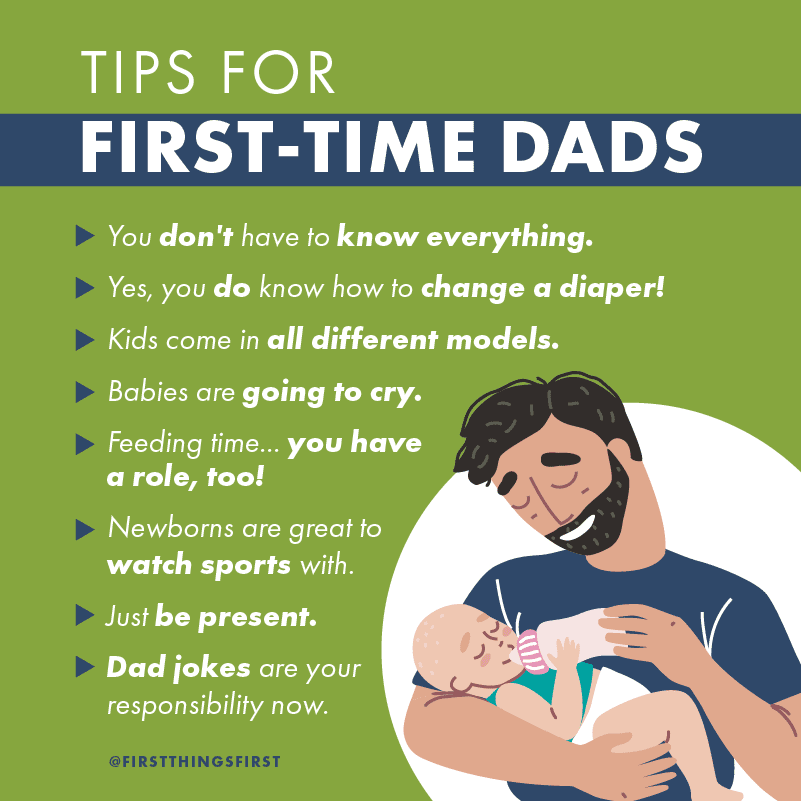
Kids come in different models.
All children are different. All deliveries are different. Your experience won’t look like mine or your buddy’s, and that’s ok. Embrace this time, ask lots of questions, and seek counsel from dads who have newborns. (I highly recommend talking to those dads; dads who have been in the game for a while may have forgotten those first weeks and months… sleepless nights are a real thing.)
Be present.
You’re not going to know everything it takes to be a dad, but one of the most important aspects is to be present and involved. Take every opportunity to hold your newborn, swaddle, feed, talk, and read to them. This all strengthens the bond between you. (And Mom will be impressed!)
Diaper duty… you got this.
The first time I changed a diaper was the day my son was born. My philosophy was that if a kid was gonna pee on me, it’d better be one I helped create. Change lots of diapers! Changing diapers is a dirty business (often literally), but it’s nothing to fear and creates an awesome opportunity to bond with your newborn. Talk to your baby and make goofy faces at them while changing their diaper.
Feeding time… you have a role, too!
Be part of feedings. If mom is breastfeeding, you’re on diaper duty… there are those diapers again. Our routine for nighttime feedings was my wife fed and I changed the diaper. We’d alternate rocking our son for a bit. Here’s a Hero Tip: If you’re bottle-feeding, own those night feedings. This is as much about mom as the baby. She will love the time to rest. Hero Status: Unlocked.
Babies are gonna cry… that doesn’t mean you should!
Babies cry, and that’s ok. What you’ll learn is that they have different cries for different reasons. You will get to know these. Make mental notes as to what sounds mean what.
Newborns are great to watch sports with.
Make your newborn part of what you love to do. My son watched tons of baseball and Moto GP races when he was little. We also took him to car shows, baseball games, and boat races. He doesn’t remember, but I can show him he was included in what I loved.
Dad jokes… everyone else is welcome.
You are a dad now, so you have a responsibility to share dad jokes every opportunity you can. Brush up on those skills, watch some YouTube videos, and be prepared for lots of eye rolls.
You’ve got this, Dad. You’ll have lots of questions, and you will learn a lot in the coming weeks and months. That’s ok—fatherhood is a journey… embrace it.
How Do I Talk to My Teen About Their Romantic Relationships?
I was sitting at my middle school son’s football game. Some parents around me were discussing who was dating who in the school. I kept quiet during the conversation, but was anxiously waiting for them to mention my son. They did. I was astonished and a little embarrassed because I was totally unaware my son was “dating.” I knew for a fact he didn’t go anywhere with anyone. That’s what I consider “dating.” All he did was talk on his phone.
How does that constitute dating?
As soon as we left the game, I must confess I blindsided him with the question, “How is your girlfriend?” [Mom Smirk.] He gave me one of those looks only a teenager could give. “Mom, I don’t have a girlfriend.” [Teen Eye Roll.] “That’s not what I heard.” The more we went back and forth, the more frustrated he became, and the angrier I became. He was ADAMANT he didn’t have a girlfriend. Truth be told, I was confused. I soon recognized that not believing him was damaging our relationship.
How could I have prevented this from happening?
Could I have better engaged my son in a conversation about his “romantic relationship?”
How can my misstep help you?
⇨ Related: 6 Tips for Teaching Your Teen Healthy Dating Habits
Learn The Language
This is a time when the teacher becomes the student. Be humble and allow your teen to teach you the new relationship lingo. Your willingness to learn and listen shows you respect your teen’s perspective and you care about what’s going on in their world.
Recognize and Accept Things Have Changed
When your teen says things have changed, believe them. The words and labels they use—DIFFERENT. The modes of communication they use—DIFFERENT. The definition of relationships—DIFFERENT. Trying to impose the “old way” on them will be met with rolled eyes, resistance, or worse.
Be An Askable Parent When You Talk to Your Teen About Romantic Relationships
Take time to listen. Be open and genuine. You might hear some “stuff” that shocks or surprises you. You have to use your poker face. You’ll be tempted to turn a conversation into an interrogation. If your teen perceives a negative reaction from you or gets bombarded with a billion questions or a long lecture, it can cause them to stop talking and create distance.
⇨ Related: How Do I Get My Teen To Talk To Me?
Build Up Your Relationship
Cultivating and maintaining your relationship with your teen provides space for this conversation. As your teen grows, your relationship with them should grow from more directive to coaching them through life and relationships. The more you try to control or force a relationship with your teen, the more they can pull away from you.
If your teen says they are in a romantic relationship, here are some conversation starters to ask your teen:
- Are you able to be yourself in the relationship?
- Do you show respect and feel respected in your relationship?
- Do you have realistic expectations about the relationship?
- Are you feeling pressured in your relationship?
- Do you feel you have the time to devote to the relationship?
The key to guiding your teen through romantic relationships is to stop being a talkative parent and become a parent your teen wants to talk to. Keeping the lines of communication open between you and your teen builds and supports the relationship.
Sure, “dating” might look different now, but there is still no substitute for a close, healthy relationship with your teen.
Check out some other blogs on healthy dating habits here:
Dad, Here Are 5 Things Your Middle School Daughter Needs from You
Just wait until they turn 13, they said. Yeah, they’re cute now, but the day is coming, they said. Then my daughter turned 13. And I admit, the days are a lot more unpredictable when you have a middle school daughter. I never know whether I’ll be driving Jekyll or Hyde home from school on any given afternoon. Hair colors change from day to day, moods change from minute to minute. One moment they are cuddling in your lap like they did when they were 3; the next moment they’re rolling their eyes at you and holing themselves up in their room.
Can you relate?
It’s a confusing time for middle school girls—they’re caught somewhere between being a little girl and wanting to be an independent young adult. They are seesawing between the two at any given moment.

It’s a confusing time for us dads, too, for obvious reasons. On the one hand, it’s hard to know what to expect out of your daughter. But more than that, it’s easy to feel like your role as a dad carries less weight than it once did. As a dad of a middle schooler, sometimes I feel like I’m a benched player when I was once a starting quarterback.
Well, as a fellow dad-of-daughters, I’m here to say that you (and I) are still in the game. And I’d like to share some words of encouragement for being the best dad you can for your middle school daughter.
Your daughter needs you to spend time with her.
Yes, she wants to exercise a lot more independence. She wants her space, her privacy. But your middle school daughter also desires to spend time with you. I mean good, quality time where she has your undivided attention. She not only wants to know you love her, but also that you like her, you like being with her, hanging out with her. Make time to do your favorite things together. Go on a coffee date, chow down on greasy cheeseburgers, take a hike, watch a movie, jam to music in the car (both yours and hers). If you haven’t already, find the activity that is going to be “your thing together.” (My daughter and I have “our” TV show that we watch together.) If you do have “your thing together,” go ahead now and make plans to do it again soon. (No, like, right now. Go ahead. I’ll wait here…)
Your daughter needs you to listen.
It used to be that I could sit my daughter down and teach her all kinds of wisdom and “life lessons,” and she’d hang on to my every word. At 13, that doesn’t work quite as well anymore; “life lessons” come across more like lectures or replays of what’s been said before. But where my daughter and I do connect nowadays is when she comes to me to talk. I’ve found the key is to do a lot less “lesson-giving” and a lot more listening. Listen to understand. Ask questions to get an idea of where she’s coming from, how she’s feeling. And always, always let her know that she can come to you anytime with anything on her mind… and you won’t respond with any kind of judgment or ridicule.
And a funny thing happens sometimes: in the course of simply listening to my daughter, somehow a nugget of wisdom will slip through the cracks and get heard by her. Amazing how that works.
Your daughter needs you to affirm her.
Lots of changes are happening in your middle school daughter’s life: brain development, friendships, body changes, emotions. It’s just a normal part of her development. But when your daughter experiences these changes, it can cause her to be unsure of herself, and she needs a regular boost of confidence. This is where you come in.
All middle school daughters need to hear certain things from their dads. Let her know how intelligent you think she is, how creative, how bright. Tell her that anyone would be lucky to have her as a friend. Don’t shy away from complimenting her physical appearance in an appropriate way: her hair, her eyes, how tall she’s getting. (My daughter is an avid cross country runner, and she beams whenever I ask her to flex her leg muscles and show me how strong she is.) Let her know she grows more and more beautiful every day. (Seriously—she needs to specifically hear the word beautiful applied to her.)
Affirming who she is and who she is growing to be can make all the difference in how your middle school daughter feels about herself and her future.
Your daughter needs you to be interested in her world.
Her world in middle school is more complex than when she was younger. She’s discovering what she likes and dislikes, trying new interests, and devoting more time to activities she can call her own. It’s important to remember she considers this part of her space, her world; but, she wants you to come over and visit often.
Ask her questions about what interests her. Allow her to be the expert on whatever it is she’s into. Ask her to tell you about her best friend, how she goes about putting color in her hair, or what’s going on in the reality show she watches. The trick is to show genuine interest without seeming intrusive or nosy. And you certainly want to avoid coming across as judgy of her friends or interests. Showing interest in her world tells her that you are interested in her and that she means a lot to you.
Your daughter needs you to believe in her.
Here’s something I realized about my daughter not too long ago: it’s possible that she’s going to do something later in her life that will absolutely change the world. I have no idea what that might be. Maybe she’ll help heal people as a doctor, or write award-winning screenplays, or solve some major crisis in a far-off country. And the same possibility holds true with your daughter as well.
Here’s the question I have to ask myself: When that time comes around, do I want my daughter to look back and see that her daddy believed in her every step of the way?
Absolutely I do.
And I’m sure you want the same for your daughter as well. Let her know you believe she’s capable of making a difference in the world around her, both now and in the future.
Dads, I’m asking you to join me in the mission of being the best dad you can be for your middle school daughter.
Let me leave you with a sobering thought: This is the stage when it’s the easiest to pull away from your daughter but is possibly the most crucial stage to stay in the pocket. You’re still in the game and called to play it strong. Your middle school daughter needs you, whether she’s Jekyll or Hyde on a given day. Now, go eat some greasy cheeseburgers with her and tell her she’s beautiful.
For more great information on being the best dad for your daughter, check out the links below:
It’s election season. Unless you live under a rock, you already know that because it’s pretty much impossible to escape the endless ads everywhere you look reminding us who to vote for.
Now imagine election season through the eyes of a child. They’re taking in the information they hear at home, possibly at their grandparents’ house, on social media, and from friends. But do they really understand what’s happening?
You might wonder if they even care. But if you’re talking about it, they’re probably at least interested in what is happening. They may feel the stress and anxiety of it all but have no idea what’s really going on. The good news is, you can guide your child through election season.
This is a great opportunity to teach your child:
How our country operates…
Talk about the different political parties, what they represent and what their history is. Look at each party’s website and ask your child what the differences are in each party’s perspective. Explain how people can become candidates and what is required of them. Discuss how the people in this country get to choose their leadership and how that differs from other countries.
Ask them what it means that we are called “the United States of America.”
Talk about the Electoral College and the role it plays in the election process. You can even get them to research why some people want to make changes in the Electoral College.
How to get accurate information…
With all of the talking heads giving their opinions about candidates, this is the perfect opportunity to teach your children how to educate themselves about the candidates and the issues versus taking all information at face value. Show them how to search for the facts concerning the issues. Talk about the dangers of believing every headline.
How to talk about the different issues with people even when you disagree…
This right here might be one of the most important skills you can teach your children through the election process. It seems as though the art of civil discourse has been tossed to the curb in our society. Model for your children how to disagree without being disagreeable.
Possibly one of the greatest things about our country is, people are allowed to not only have an opinion, but they are also allowed to openly state that opinion without fear of being killed for it by the government. That’s not the case in many other countries where dictatorships exist.
Modeling how to respectfully have a conversation with someone who has differing opinions will show your children not only that it’s possible, but that it’s educational. Show them how to ask questions and to be curious about why someone believes what they believe. Let them see you listening to the person’s perspective and even saying things like, “I appreciate your thoughts on that. I’m not sure I agree with them, but I appreciate your perspective.”
While you may not want your children to watch the debates live, you can watch it with them later. Doing so and asking them what they see, how people treated each other when they disagreed, what they learned about the issues, how they know what is true, etc., is a great educational experience.
Most children, until the middle or high school years, are likely to parrot their parent’s opinion. Start early teaching them why it’s important to decide what you believe. Let them know it’s also important to have people in your life who don’t necessarily see things exactly the way you do. Having people in your life who have differing opinions makes your life richer.
What it means to have the right and privilege to vote, and why it matters…
The freedom to vote has been a long road for many people and there are still struggles today. According to the U.S. Census Bureau, only 61.4 percent of Americans eligible to vote actually did so in the 2016 presidential election. The irony of this is that voting is actually how you have a real voice in the process of selecting our leaders. Even if your candidate doesn’t win, you still have a say.
Last, but not least, let’s talk about relationships as you guide your child through election season.
The way you engage with the people you love matters and can impact whether they feel safe and secure in their relationship with you. As many are experiencing right now, even family members don’t necessarily agree about who to vote for, and that’s ok.
Sometimes this can make family life really stressful, especially for children. At the end of the day, remember, relationships are more important and long-lasting than your political perspective. When your children see you respectfully disagree, share your own opinions, listen objectively to other points of view with extended family members, friends or even your spouse, they’re learning what it means to have civil discourse about elections at a moment in time when everybody believes there is a lot at stake for the future of our country.
Photo by Ketut Subiyanto from Pexels
My Child Is Unhappy. What Am I Doing Wrong?
Your child is giving you that look. The one that makes you feel like you should’ve done better even when you did the best you could. You know they’re unhappy and you feel like you’ve tried everything to cheer them up and nothing’s working. As a parent, we’ve all been there, and the truth is, the moment passes… most of the time.
When my children were younger, we would go to a small family amusement park near our home. We’d invite friends and family to go as a group usually on a warm summer Saturday afternoon. Inevitably the normal summer afternoon rain shower would start just as we were headed for our outing. Because those afternoon thunderstorms were accompanied by lightning, we’d have to postpone or even cancel our plans. I knew my son would be in a mood for days if we actually had to cancel. I’m talking full-on sad, pouting, and disappointed look on his face. I’d try to cheer him up by saying we can go next weekend or by taking him to another fun place for kids. But his mind was set; it was like I couldn’t offer up anything as good despite all of my best efforts, I still had an unhappy son.
Things have changed in ways we never expected this year. COVID-19 has taken away our access to normal activities. Your child may have missed spring sports, annual family trips, or even dealt with the death of a loved one. You get to teach your child how to process and move through a variety of emotions including moments of disappointment and being unhappy. As a parent, you can do everything in your power or even give your child their biggest wish, and they can still be UNHAPPY.
Your child actually gets to choose whether they are happy or not. Hal Runkel, LMFT, often says, “You are responsible to your kids, not for them.” In most instances, you, the parent, are not at fault nor did you cause your child’s moment of unhappiness. You do have the opportunity to help them see the positive and be happy even in difficult situations.
Here are ways you can create an environment that decreases moments of unhappiness.
- Know Your Child Is Watching You.
As parents, we model for our children many different things including how we deal with emotions. Your child is very perceptive and in watching you may recognize and mimic your emotions. If you’re dealing with stresses that impact your emotions, your child may also demonstrate the same reactions. It’s good that your child sees you have a variety of emotional responses. Also, be aware if you try to put on a “happy face,” your child will often see through that. They learn being sad or unhappy or angry is normal and how you can get through it.
- It’s Normal For Kids To Be Unhappy When You Set Limits.
Many parents want their children to always be happy. That’s a lot of pressure to place on yourself. Primarily, it’s your job as a parent to provide consistency, structure, rituals, and routines for your child. As a result, your child may display unhappiness when you set and stick to limits such as bedtime, eating vegetables before dessert, tech device access, or saying NO to what they want. It’s also important to recognize that children often “want what they want” and can use their emotions to manipulate getting their way. Don’t fall for it.
- Allow Children To Express Genuine Emotions.
If a family member is sick or a family pet has died, it’s good that your child can express their emotions of sadness and unhappiness to you. Allow them to genuinely and authentically share with you what they are feeling. This strengthens your connection. Children feel supported and secure when parents can hear and handle their emotions.
- Teach Emotional Intelligence Skills.
Your child’s personality may be more optimistic or pessimistic. No matter the case, it’s important to teach your child they are responsible for how they respond or react to any given emotion. In addition, skills such as gratitude and even thinking happy thoughts are ways to build their emotional skills.
- Playtime Can Make It Better.
Play, whether it is structured or unstructured, promotes intellectual, physical, social, and emotional well-being. Children learn how to work with others, handle conflict, and regulate their emotions while playing. Getting outside to play not only encourages bonding with your child, but it also releases endorphins which naturally improve your mood.
In some instances, there are very good reasons why your child is unhappy. A divorce, death, move to a different city, or even across town would be challenging for most children. What happened may be completely out of your control. If you feel like you’ve tried everything you know to help your child adjust, you might want to consider seeking professional help to guide you as you seek to assist your child in dealing with their ongoing feelings of unhappiness.* If your child has health issues or mental health issues, seek professional help.
We want our children to be the best they can be. We want successful, smart, and happy kids. Providing them with emotional and physical security along with age-appropriate behavioral expectations goes a long way. Creating an environment for them to flourish and grow begins with you.
How to Protect Your Family’s Mental Health
Nothing seems normal these days. Many people say, “I just keep pinching myself thinking I’ll wake up and this nightmare will be over.” Sometimes life can take a real toll on everyone – both physically and mentally. As you continue to navigate through these times, there are ways you can be intentional about protecting your family’s mental health.
For starters, it’s important to continually remind ourselves that when we’re going through something that’s very unusual, we remain in a heightened state of anxiety and stress that impacts our mental and physical health.
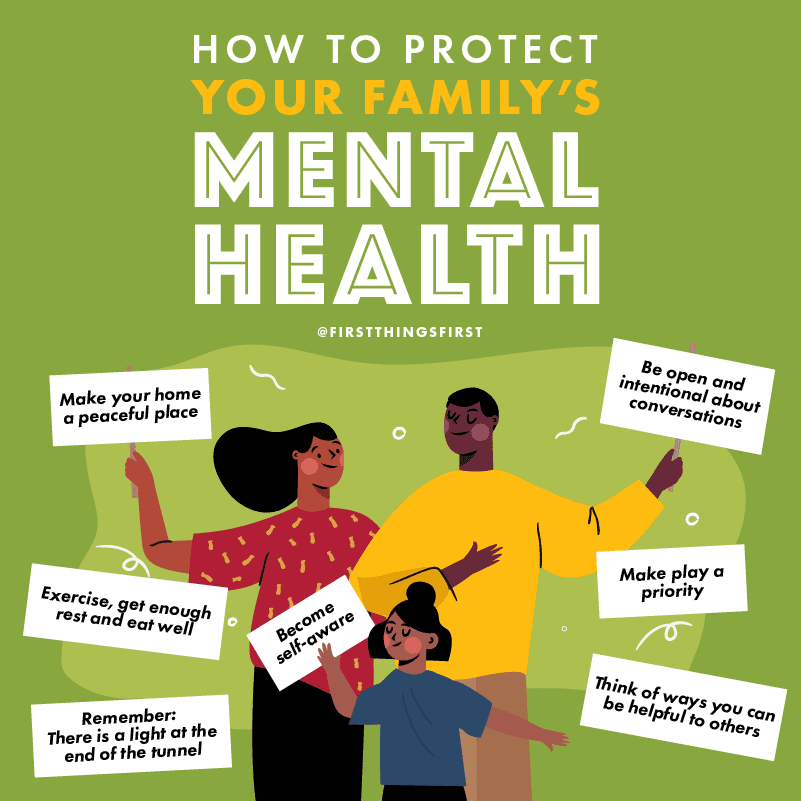
One thing that can help you regain your footing is to establish routines, rituals, and structure.
In times of high anxiety and stress, the consistency of routines and structure is soothing to everyone.
Make your home a peaceful place—a refuge from all the craziness going on in the world.
Spend some time thinking about things you can do to create calm. Play calming music, light a lavender candle and let the sunlight in. Encourage your children to find a comfy spot where they can read or play with their toys.
Be self-aware.
Your children are like sponges. Whether you notice it or not, they’re watching your every move, your facial expressions and even listening to your conversations that don’t include them. They’re quick to pick up and take on your stress and anxiety. Have adult conversations out of the hearing range of your children. Be proactive in dealing with your emotions.
Be open and intentional about having conversations about things that are going on in your world.
Ask your children to tell you what they know or have heard. Use their information as a platform to affirm accurate information and correct inaccurate details. Assure them that your job is to make sure they are cared for and protected and you are doing that.
Exercise, getting enough rest and eating right are three essentials for protecting your family’s mental health.
This is like the trifecta right here! Walk as a family and insist that people get the rest they need. Involve everyone in creating fun, healthy meals.
Limit the amount of time you and your family members watch the news.
This one action can dramatically decrease the anxiety, stress, anger, fear and drama in your home. Mentally and emotionally, our brains and bodies aren’t meant to live in a constant state of stress, but that’s exactly what happens when we watch news nonstop.
Think of ways you can be helpful to others.
During difficult times, it’s easy to become focused on yourself and all that’s wrong with the world. A great way to combat this as a family is to look for ways to help others. Deliver food, do yard work, run errands, bake bread or cookies and share them with your neighbors. (Let your kids do a ring and run when they deliver. It can be your secret!)
Make play a priority.
Seriously. Play releases all the feel-good hormones that promote an overall sense of well-being. Heaven knows we could all use a triple dose of that right now. Ride bikes, go for a hike, play hide and seek, tag, kick the can, four square, hopscotch, double dutch jump rope or any other active game you can think of. Just get moving!
Remind yourself and your family members – there is light at the end of the tunnel.
This is hard and there are parts of dealing with life right now that are not fun, but together as a family, you can do hard things. When one person’s having a hard day, other family members can be encouraging and affirming to help them get through it. Having healthy relationships with each other is one of the best ways to protect your family’s mental health.
When parents model and lead using these strategies, children learn how to navigate through hard times in healthy ways. It shows you believe they have what it takes to keep going even when things get really challenging. This builds self-confidence and helps them learn how to think and be creative in the midst of change.
A side note: if you feel like members of your family aren’t handling all that is going on well, don’t hesitate to seek help. Talk with their pediatrician and/or a counselor to seek guidance on other ways you can help them.
If you or someone you know is struggling and you need immediate assistance, you can find 24-hour help here:
Substance Abuse and Mental Health Services Hotline: 800-662-HELP (4357)
National Suicide Prevention Lifeline: 988 or 800-273-TALK (8255)
Photo by Elly Fairytale from Pexels
When you found out you were expecting your second baby, you probably began to fantasize about your children getting along. You may have even imagined them playing with each other, being best friends, and loving one another as only siblings can. However, it’s not unusual for your toddler and their new baby brother or sister to get off to a rocky start.
Here are some ways to help your toddler have a positive experience as they adjust to their new baby brother or sister.
- Give a gift from the newborn to the toddler. It’s like the new baby is saying, “I’ve come to make your life better, not take away from it.” Your toddler sees the many gifts their new sibling is receiving. A new toy for them subtly lets them know they’re not forgotten and they are no less important. You can offer simple gifts like coloring books, a new toy, books, or their favorite treats.
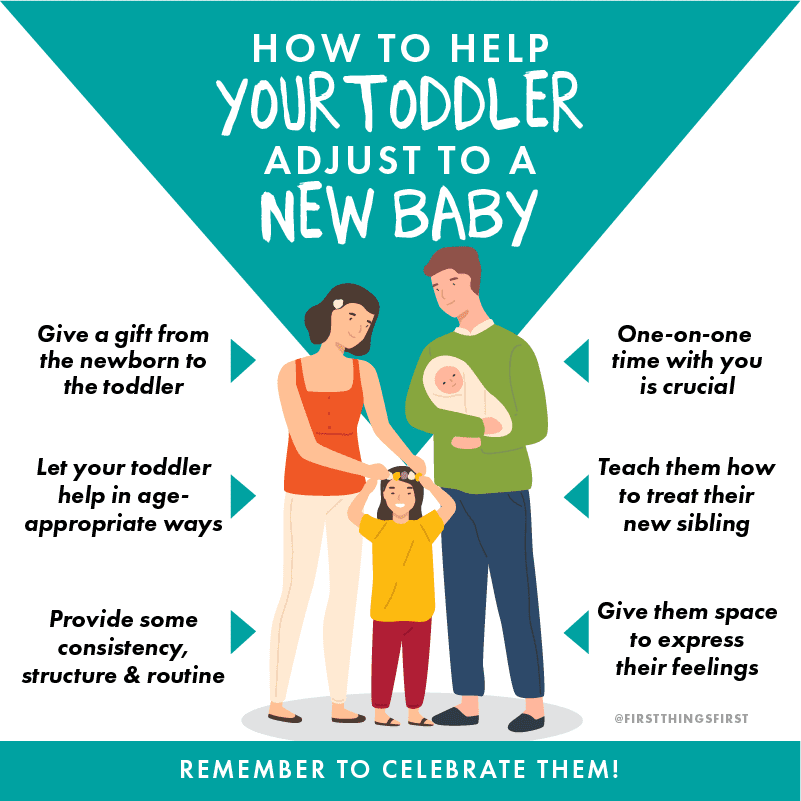
- Let your toddler help in age-appropriate ways. This can begin prior to the birth of their new sibling. Placing infant clothes in drawers, setting up the nursery, putting away silverware, and helping you make up the beds are small ways to help your toddler get into the mindset of giving. When the baby arrives, keep them involved and helping. Toddlers can become anxious they aren’t going to get time with their parents because of all the attention to the new baby. Helping you equates to spending time with you and that can help them adjust to the idea of having a new baby around.
- Celebrate them. Children tend to keep doing what draws attention. Praise them when you notice them being helpful, treating their new sibling kindly, or simply see them making good decisions. Tell them “thank you” when they bring you a new diaper for the baby or clean up after themselves. Let them you’re proud of them for being a good big brother or sister.
- One-on-one time. Find a few minutes each day to spend with your toddler. You can spend that time playing with toys, reading books, or telling stories, making something together—anything they enjoy. You don’t necessarily have to be separated from the baby to accomplish this. While nursing, you can cuddle, tell stories, rub their head, and play. While one parent is tending to the baby, the other can use the opportunity to give your toddler some personal attention. As they look at you and smile, they’re telling you they are glad you’re still their parent too.
- Teach them how to treat their new sibling. They may not truly understand the difference between a baby and a doll. Talk to them and model what being gentle looks like. Explain to them how babies need milk, diapers changed, and to be held with care. Crying may indicate that something is wrong or they are hurting. Talking and modeling will help them understand this is a person who can experience things just like they do.
- Give them space to express their feelings. Just because you do everything “right” doesn’t mean they won’t experience some jealousy, sadness, or confusion. Have them pick out emojis that show how they’re feeling. Ask them questions, like are you happy today? Is your new sibling making you feel good or bad? The opportunity to share will give them a sense of value, connectedness, and security from the person your toddler adores most—you, their parents.
- Provide some consistency, structure, or routine. Keeping a consistent bedtime routine, storytime, or regularly eating meals together helps your child see that the new baby isn’t here to just change everything. It sends the message that we have a new addition to our family. Your toddler didn’t lose when you have a child; they added to their lives.
New siblings can bring joy and a new freshness to the family. However, there are challenges that can arise as you try to help your toddler adjust to not being the only one getting so much of your attention when the new baby arrives. Helping your toddler experience this new season as an addition to their life and not something that takes away from their relationship with you can ease the transition. Change can be difficult for anyone. And don’t forget about your spouse either!