
How to Talk to Your Kids About Politics
We’re told there are two things we don’t talk about in life: politics and religion. The only problem is, this “rule” sets us up for failure when these topics come up in conversation. Inevitably, most of us don’t know how to talk about them in a healthy way.
Children are exposed to endless amounts of information in our connected world. As parents, it’s our responsibility to prepare our kids to be good citizens. We can help our kids learn how to talk about sensitive topics like politics.
My wife and I have done a lot of research, trial, and error to figure out how to productively approach the conversation about politics with our elementary-age kids. Here are 6 tools we’ve used along the way and would like to share with you:
1. Decide your children’s intake.
With younger children, parents play the role of gatekeepers. While we can’t control what they hear at school, we can shield them from much of what the media shares. They haven’t entered the world of social media yet. When it comes to parenting and politics, we can choose how much information our kids receive.
Remember, kids are sponges. They hear everything and will repeat what they hear even if they don’t have the facts straight.
2. Frame the political discussions within your family values.
As you discuss politics with your children, frame the conversation within your family values. Some of our values are kindness, humility, and honesty. Ask your kids questions that reflect your values.
- Does this feel true to you?
- Was that a kind thing to say or do?
- Do you think that person cares more about themselves or others?
- Do you think this person is a good leader?
I’m astonished at the way my 5 and 8-year-olds think. They see the character traits of others and are quick to call them out. They keep us on our toes, for sure.
3. Teach your children about citizenship.
As citizens, we have a responsibility to be engaged in government. This is the foundation of our government system. Talk to your kids about what it means to be a good citizen. Start with the local level. Teach them about what the city council, school board, and mayor do. Help them understand how citizens can be part of the political process.
4. Talk about the issues, not politics.
Focus on the issues. What’s important to your family? I have a newfound interest in who is on the school board and their decisions since I have kids in elementary school. Help your children identify the issues and see where each side stands. Discuss the pros and cons together.
5. Avoid the ugliness of politics.
Let’s face it; we all celebrate when elections are over because we’ve been overwhelmed with endless political ads. While election season can be especially ugly, it doesn’t end there. Remember, you control how much exposure your child has to politics. Be diligent in keeping them away from the name-calling. With the internet and social media at our fingertips, we have a full spectrum of news sources (not to mention family and friends). Remember—you’re the gatekeeper.
6. Help your children form their own opinions.
As parents, we have the responsibility of raising adults. I want my children to contribute to society and influence others. Present the facts to your kids and help them form their own opinions.
We’re often heavily influenced by our parents’ views and beliefs. This isn’t bad, but we have the opportunity to help our kids process what’s important to them.
Remember to focus on values and issues. A lifetime of decisions and information influences your political stance. Your children don’t have that wealth of information, but you can help them decide based on values.
Don’t fear talking about politics with your kids. It’s a part of everyday life, whether you’re talking about your mayor and city council or the President and Congress. The conversation is ongoing. Give them room to ask questions as well. Encourage their curiosity.
Related Resources:
I Feel Like I’m In A Constant Power Struggle With My Child!
“NO!” Do you remember how you felt the first time your child dead-eyed defied you? As a parent of very strong-willed sons, I remember the first time my oldest said, “NO!” when I asked him to pick up his toys in the living room. I was so taken aback I said to myself, “I must have misheard him.” I repeated, “Please pick up your toys.” He matter-of-factly repeated, “NO.”
As a parent, I had just entered the Wild West. Gone was my compliant, sweet child. He was replaced with this toddler-gunslinger who shot down everything I said.
How do I make sure I keep my sheriff’s badge during a power struggle with my child?
Remember, you are in charge.
As a parent, you have the authority in your home. You wear the badge. Remember, you also have the life experience and emotional control that your child doesn’t have. Engaging in a “power struggle” with a child gives the power to the one who can least handle it. To remain in charge, you have to keep your cool. Take a few deep breaths and relax that trigger finger.
No one knows how to push your buttons like your child. It may feel like they are trying to wrestle control from you. (And they are.) But they are also trying to become their own little person. This is an ongoing and sometimes painfully frustrating process, but keep in mind, you are laying the foundation for those tween and teen years when the stakes are much higher.
Choose your battles wisely.
Everything is not a big deal. Stop. Say that with me. Everything is not a big deal. Keeping your child safe and healthy as they grow is the priority. Worrying that their clothes are not color-coordinated is just wasted worry. A friend of mine created stickers that said, “She dressed herself.” She placed them on her child’s back so she wouldn’t feel judged as a terrible parent whose child didn’t have on a matching outfit. (But why are we even worrying about what other parents think about us?) Ask yourself, “Is my child safe, healthy, and happy? Then, is this the hill I want to die on?“
Give your child choices.
The non-negotiable might be getting dressed, but you can say, “Would you like to wear this outfit or this one?” You just shifted the issue from “getting dressed vs. staying in jammies” to “this outfit vs. this outfit.” Your child gets to exert their little will, but only within the options you gave them.
As your child grows, they are trying to figure out who they are. Allow them to make age-appropriate choices and decisions. You end up with a win-win situation. Your child feels empowered, and the job gets done with little to no conflict. You’re running this town, but the on-the-job stress is manageable.
Be specific and make it fun!
You have to be specific when giving your child a task. They might not be ready to process, “Clean your room.” Break the job down into smaller tasks. Pick up all your books and place them on your bookshelf and report back to me when you’re done. Make chores a game when you can. Use a hula-hoop and place it on their floor; then grab a kitchen timer. Let’s see how fast you can put away everything in the hoop! Then move the hoop to another section of their floor. Can you beat your last time? You no longer have a power struggle with your child. Instead, you have created a fun game!
Don’t be afraid to deputize the universe.
You read that right. Use natural and logical consequences with your child. Let the universe do the heavy lifting. Consider the following:
Parent: Hey, it’s chilly out. You might want to put a hat on.
Child: No, it’ll mess up my hair. I don’t want to.
Parent: Okay, that’s your choice.
✦ Now, one of two things is gonna happen, but neither involves a power struggle with your child. Either your child will be chilly and will want a hat next time, or your child will be completely comfortable without a cap. Either way, you get to sit back and watch your child interact with the universe and learn a life lesson. You avoided conflict with your child. You were the guide to the side, letting your child learn about choices and consequences while the stakes were small.
This “growing-up” process for your child may feel like a roller coaster for you. The ups, downs, and loopty-loops can take your breath away and stress you out. That badge is a privilege and a responsibility. If you are upset and yelling—you’re losing. As the parent, you are the law in these here parts.
How To Identify Your Child’s Strengths
The crack of the bat. The cheers. The applause. My son just hit the ball over the head of the second baseman to collect his first hit of the game. This isn’t the proudest moment of the game for me, though. My proudest moment came an inning earlier when he struck out for the second time of the night – as I watched him walk back to the dugout with his head held high… no pouting. He put his bat and helmet up and cheered for the next player up to bat.
When we think about the strengths of our children, we often think about what they’re good at, like math, reading, sports, spelling, writing… the list goes on. These strengths are good and deserve recognition, but what about the strengths of character? As parents, we can help our children recognize character strengths just like we do physical or mental strengths.
Lea Waters, Ph.D. says, “Strengths are things we do well, often, and with energy.”
Here are some clues you can use to identify your child’s strengths:
- There’s a Drive or Yearning. Your child will have a desire to use their strengths. They will look for ways to express it.
- Your Child Naturally Displays It. Observe what they naturally do or say. My son loves to read and write. He loves history and he will find videos to learn about a specific subject and then write his own book about what he learned. This is a natural curiosity; he’s always asking questions. He’s used this strength to help his classmates who may be struggling with schoolwork. My daughter (age 4) loves to draw. It’s how she shows her creativity. There are pictures taped all over our house of her drawings. She uses this to draw pictures for her friends and family. This is a way she shows love and care for others. Often, it’s a form of encouragement to others.
- Your Child Loses Track of Time When Engaged in It. It’s hard for children to focus on one task for too long. So when they do, pay attention to what it is. When they lose track of time engaging in an activity, they are doing something that energizes them and brings joy and fulfillment.
- It Can Be Put to Positive Use. As we help our child discover their strengths, let’s look for ways for them to positively impact others. You can hear more about these clues from Lea Waters here.
You don’t have to respond to each strength you discover, but you can take steps to encourage them to develop some further.
Remember, just because your kid is good at something doesn’t mean they enjoy it. As we help our child identify and develop these strengths, we can help him or her understand the character traits that accompany them.
You have the opportunity to help your son or daughter discover what makes them unique and how they can utilize who they are to make a positive impact on the people around them. You get to walk this path with them, encourage them, and strengthen your relationship through this process of self-discovery. I, as a parent, am the most influential teacher my child will have. I have the privilege of pouring into and encouraging their development. You do too!! Use this strength development journey as a way to grow your relationship with your child.
How To Encourage Your Child’s Strengths
She’s never going to want to run ever again. I told myself this watching my then-10-year-old daughter run in her first elementary school track meet, lagging behind the faster runners, red-faced, and breathing heavily. She wasn’t last, but she certainly wasn’t first. My heart sank for her. As she (finally) crossed the finish line and I went to meet her, nothing could have made me guess what would happen next.
The girl loved it. She went on and on about the strategy her coach told her to use, the fact that she had passed another runner (albeit the one that came in last place), and how she felt herself “kick it in” on the last leg. Well, I’ll be darned.
Fast forward three years later. (Warning: total dad-brag about to happen…) Today I watched my daughter run in the second cross country meet of her 8th-grade year… as a member of the varsity high school team. She came in 8th place overall. And afterward, she went on and on about her strategy, passing the girl in front of her (actually, several girls), and “kicking it in” over the last hill. She’s found something she loves.
It’s so amazing to see your kid discover and develop their strengths. And although I can’t take much of the credit (because let’s face it—I’m not about to run three miles in the hot August sun in the middle of a field), I’d like to think that my wife and I did something right to help her develop her love of running.
Have you seen that spark in your child’s eyes when they’ve found something they’re strong in?
Whether it’s an external activity like running or painting, or an internal quality such as compassion for others, you can use some definite strategies to encourage your child’s strengths.
Encourage experimentation.
Kids in that 8 to 12-year-old range are in a stage where they are naturally “trying on” pieces of themselves. They aren’t quite sure if they’re into competitive sports, artistic activities, problem-solving tasks, specific topics of study, or a combination of these! In our house, we’ve always had a philosophy of “if it piques your interest, let’s just try it.” There were definitely activities that were off the table; neither of my daughters had any kind of an interest in softball or basketball, so we didn’t push it. But if there was any hint of I wonder what that would be like, we did what we could to find short-term opportunities to try it on for size. (We prompted our runner-daughter to attend a week-long cross country camp the summer after her 5th-grade year, where she fell in love with the sport, and the rest is *current* history!)
Here’s another approach: a friend of mine has a rule with his family where each of his children is to be involved in one artistic activity and one physical activity. This is a brilliant idea to encourage your children to discover and build on those strengths.
Throw them in the deep end of the pool.
After falling in love with cross country at summer camp, it was a no-brainer for my daughter to want to run on the middle school team the following year. My response to her: Okay, but if you’re going to commit, you’re going to commit. What are you going to do to prepare yourself for the upcoming season? The result: several days a week over the summer, she ran as far as she could while I biked beside her (Did I mention I don’t run??).
When your child has found that thing they are interested in, encourage them to dive in headfirst and soak up every ounce of experience they can with it. Coach them and encourage them in experiencing both the joy as well as the gritty work that comes with their strengths. (Running is fun when the conditions are right, but you have to be willing to run in the rain and the cold if you want to get better.) Obviously, approach this with a strong dose of grace. But help them see the value in improving upon what they are passionate about.
Ask lots of questions.
A surefire way to encourage your child in their strengths and interests is to show interest yourself. Assume the role of the complete novice and allow them to be the expert. There have been so many conversations about running simply sparked by my asking a “dumb” question. (So, when you’re in a race, are you allowed to elbow people? And off we go on a great discussion on cross country rules…)
Don’t forget to ask questions like, “Are you sure you still enjoy this?” Just because a your child is good at something doesn’t mean they enjoy it or can’t get “burned out” on it. Sometimes parents try to live out their dreams through their children. Just because you were a great swimmer, and maybe your child is too, it doesn’t mean they share your passion for it. They might hate it. Ask questions to make sure your child isn’t participating in something because they know it makes YOU happy.
Help them find other sources of inspiration for their strengths, especially things to read.
Kids will naturally eat up any kind of extra bits of media and information on the strengths they are passionate about. Art, books, hiking magazines, cooking tutorial videos, photography blogs… all these are great resources to “pass along” to your child who wants to go waist-deep into their strengths. For her birthday a couple of years ago, I bought my daughter a subscription to a women’s running magazine. And now, I am receiving a constant education on the value of spiked running shoes, how to train for marathons, and what you should eat before a race (evidently chocolate cake doesn’t make the list).
Help them find a community that will encourage them in their strengths.
It’s one thing to encourage your kids from the home front to pursue and strengthen their interest. But your encouragement receives an extra boost when you help them find other kids—just like them—who are passionate about the same thing. And let’s face it: not every interest has a ready-made team waiting for them (like, say, cross country). But nowadays, if you look hard enough (like internet searches of what’s in your community), you can usually find a common interest group with just about any activity. And if you can’t, talk with your child about starting a group yourselves. There may be a huge number of kids ready to come out of the woodwork to share their passion for bead art, geocaching, or videocasting with others… just like them.
Help them and encourage them to match their strengths to goals, projects, and experiences.
In his (excellent) book, Artificial Maturity, Tim Elmore says that directing kids’ strengths toward real-life ventures helps them form a clear sense of identity and prepares them for life as an adult. You can’t go wrong with that. And besides, giving your child a sense of mission with their strengths puts meaning behind their interests.
For example (warning: another dad-brag is coming your way…), my younger daughter discovered an interest in videocasting. She formed her own YouTube channel, recorded herself hosting topics from craft projects to how to clean your room to fun family activities. Then she edits and puts the videos out there for family members and close friends to view. (I have had the distinct honor of guest-starring in a number of her productions.)
Again, I can’t take all the credit, but we’ve tried to encourage her as best we can and help her think how she can use this interest to help other people.
As a new 6th-grader in middle school, she has built upon those strengths and has now transitioned to hosting her own podcast, using her school’s recording equipment to interview teachers in her school about their experiences as young people and making it available to the students. (Seriously, I’m totally humbled by my kids. At their age, I was content just reaching the next level of Pac-Man.)
One last thing about encouraging your child’s strengths…
At times I have done the above very well with my kids, and other times… not so well. But I have found that encouraging my kid’s strengths has actually afforded me opportunities to connect with them and have a deeper relationship with them. The conversations that have resulted have been invaluable. And I wouldn’t trade the experience of riding my bike (what felt like) hundreds of miles beside my oldest daughter running or hamming it up on video with my younger daughter for anything. And I’m pretty confident they won’t forget those times either. Value those times and soak it up. It’s amazing to see your kids grow.
Image from Pexels.com
How a Parent’s Emotions Can Affect Their Child
I woke up late because I forgot to set my alarm, so I hurried to the shower and got dressed. Then I rushed to my son’s room to get him up and ready for the day. On my way to the room, I’m greeted by a BIG smile and my son saying, “MOMMY, look! I helped you. I got dressed and ‘made’ my breakfast.” He was dressed like a bag of skittles. He had on a purple shirt, lime green shorts, red socks and his blue shoes. Breakfast consisted of a peanut butter and jelly sandwich with a glass of milk. Actually, only half of the peanut butter and jelly made it to the bread. The other was spread on the table, and none of the milk made the glass. It was in a puddle in the middle of the kitchen.
I was experiencing a variety of emotions including feeling stressed, bothered, frustrated and angry.
My son watched what was going on on my face and waited for my response. What could I say or do? I could yell out of frustration and anger. Or say, “YOU made such a MESS! I don’t have time to clean this up. We are GONNA be late! What are you WEARING?” Or, I could laugh, open my arms, and say, “OMG! Thank you for helping Mommy this morning. I was running behind. I appreciate you dressing yourself and eating your breakfast.”
No matter the response I chose, one thing is for sure: my response will have an impact on my child.
Here’s 3 ways your emotions can affect your child:
1. The way you behave when you experience an emotion teaches your child about that emotion and how to respond to it.
Emotions are not good or bad; it’s what you do with the emotion that will be either positive or negative. Your child needs to see you express a variety of emotions from anger, sadness, stress, anxiety, joy, elation, frustration, disappointment, pride, boredom, tired, scared, and nervous.
2. Your child is watching to see what you do or how you react to a given situation.
There may be times when you struggle with a work assignment, and you feel frustrated and annoyed. Saying to your child, “Mommy had a HARD DAY at work and I need you to complete your homework or chores the first time that I ask you.” You are modeling for your child that having a bad part of the day doesn’t have to ruin the whole day.
3. Children recognize fake and faux emotions.
If you’re actually sad, but try to fake happiness for the sake of your child, you’re doing them a disservice. Because your child can see that you’re sad, they may actually believe that it is because of them you are SAD. As you experience emotions, have an age-appropriate conversation with them. You are teaching them how to deal with emotions which is a skill that has long-lasting effects.
If you have younger children, they are not immune to the effect of your emotions. They are often unable to verbalize their negative feelings so they display them by acting out. They may revert to a younger stage like sucking their thumb or having bathroom accidents. You may also notice them not wanting you out of their sight or being extremely weepy.
As a child, you may have learned lessons from Mr. Rogers’ Neighborhood.
These are a few poignant words he has to say about feelings. “There’s no ‘should’ or ‘should not’ when it comes to having feelings. They’re part of who we are and their origins are beyond our control. When we can believe that, we may find it easier to make constructive choices about what to do with those feelings.”
As a parent, you have the opportunity to teach your children that having a variety of emotions is normal and natural. How you either react or respond is the lesson they learn. Because your child has been watching you over time, it may be a shock how accurate they are in interpreting your emotions. Whether you are happy, excited, angry, or frustrated, your child is aware. Your increased awareness of that fact helps to create a calm, peaceful and stress free environment for them to grow and develop.
Image from Pexels.com
Seven Things Every Child Needs to Thrive
Does it seem like everyone has something to say about how you’re parenting?
Do you question whether or not you’re doing the right thing for your child?
Do you want assurance that you’re meeting your child’s needs?
Researchers and practitioners have sought for years to find what children need to thrive in a variety of ways—physically, mentally, psychologically, emotionally and behaviorally. The research is in. They might use a different word or two, but we have a good idea about what children need to thrive. Relationship is everything.
Dr. Mark Laaser and his wife, Debra Laaser, LMFT, have worked with individuals and couples for many years. Through their work, they found that in relationships, we all have desires in our hearts. Those desires begin in childhood and last throughout our lives.
1. To be heard and understood.
Your child needs you to hear and listen to them, even when what they say is difficult to hear. If they don’t feel heard, they will either stop talking or begin to over-talk you.
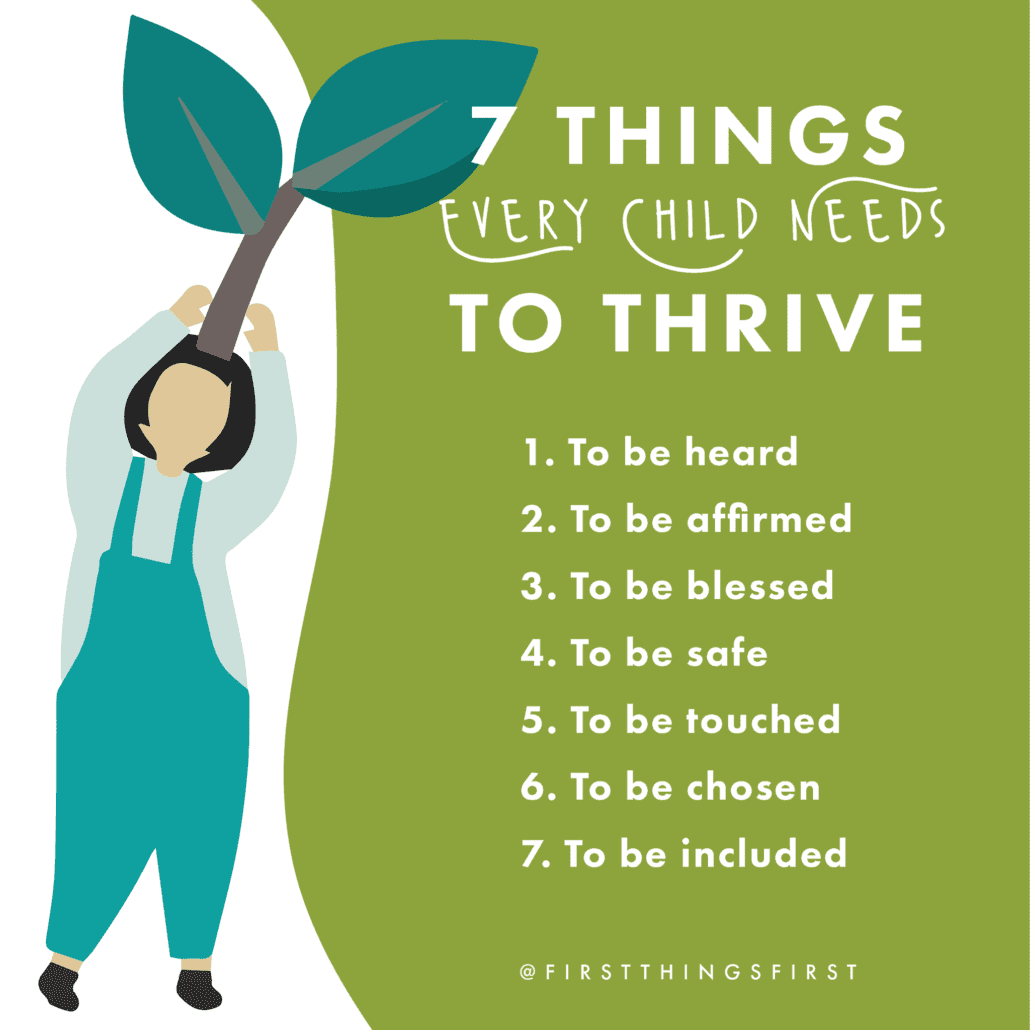
2. To be affirmed.
Your child desires for you to recognize what they do. Whether for academics, arts, or athletics, you showing up means a great deal to your child. They may win or just participate, but your acknowledgment that they did a good job can make their little hearts happy. When they complete a task or chore, saying thank you (even if they don’t do it the way that you do it) is an additional way to notice their contribution to the family.
3. To be blessed.
Your child desires to know that you love them unconditionally for who they are not for what they do or accomplish. No matter how they behave (temper tantrums), how successful they are in athletics or not, how well they do academically or not, your child needs to feel your love and support.
4. To be safe.
Your child desires to feel safe, free from extraordinary fear, worry, and anxiety. There are conditions that parents can’t control such as a global pandemic or natural disasters (tornado, hurricanes, fires). What you can do is ASSURE your child that you are right there with them. Being aware of your feelings will help you handle those of your child.
5. To be touched.
Your child needs and desires physical contact. As infants, children who don’t receive physical touch often get a diagnosis of “failure to thrive.” According to Dr. Virginia Satir, “We need four hugs a day for survival. We need eight hugs a day for maintenance. And we need twelve hugs a day for growth.”
6. To be Chosen.
Your child desires to know that you want and cherish them as a member of the family. In my house, my sons often ask, “Who is your favorite child?” The truth is each one is my favorite child. Our family would not be the same if any of them were not a part of it. Likewise, your family would not be the same if any of your children were not a part of your family.
7. To be included.
Your child desires to know that as a member of your family, they matter, belong, and have significance. Find ways (age-appropriate) to include them in decisions (what’s for dinner, family outings). Not only is their presence necessary, but their contribution to the family ideals and expectations is mandatory.
Parents want the best for their children through experiences and exposure. There will be times that you miss the mark as a parent. Your child may not make every team or production they try out for. You may get angry and raise your voice. Remember that what your child needs to thrive is for you to be an engaged (not perfect) parent who is seeking to meet the needs and desires of your child’s heart. There are probably a few things that you’re already doing, but if you see one that you’re not, choose one to focus on this week.
Other Lists Of What Children Need
Why We Need to Stop Judging Parents for Every Decision They Make (and How to Do It)
I see the mom walking down the street with her 4-year-old daughter paying more attention to her cell phone than her daughter, and I think, “Put your cell phone down and pay attention to your daughter.” I see the mom at the grocery store at 1 AM with her 2-year-old son and I think, “That’s ridiculous.” I see the 6-year-old talk disrespectfully to his parents at the soccer field and I think, “If he were my son, that’d never happen.” And let’s not mention the thoughts that have gone through my mind when I see the temper tantrum in the grocery store line next to the colorful Skittles that the child wants and can’t have.
Judging other people’s parenting can be intense and destructive to my well being—and it just plain isn’t fair to other parents. When we judge others, we’re sending the message that we’ve got all the answers. Any parent knows this just isn’t the case. Why do we judge other parents and how can we stop?
We judge for many reasons:
- We parent differently. Breastfeeding vs Bottle. Educational decisions. Kid’s use of technology. Our natural tendency is to see those who parent differently as wrong. Because if they are right, then I’m wrong. Instead of just seeing them as different. There’s usually more than just two ways of parenting.
- We develop strong opinions about our beliefs regarding what is the best way to parent. Some of those strong opinions can lead us to judge others who have different beliefs.
- Our rush to determine a person’s character. Research has shown that someone’s character is more important to us than what they know and their sociability so we rush to make a judgment on their character. We parlay our own circumstances, environment, and experiences onto parents we’re judging without considering that we’re looking at a moment in time without full context. Dr. Elizabeth Hall in Psychology Today says that we take a behavior and instead of thinking about how the situation may dictate the behavior, we attribute it all to the person’s character. For instance, we see Mom letting her 5-year-old use the cell phone and we make a snap judgment about the mom without even considering that they could be communicating with a grandparent at the moment.
When we judge we make ourselves less approachable. We also separate ourselves from the authentic parenting community. We’re less able to help others and to receive help. Even if a parent is in the wrong and could use the help, who wants to listen to someone who looks down on them or thinks they are better than they are?
How do we stop judging other parents?
1. Recognize we all make mistakes and have limitations.
We have all forgotten to pack extra diapers. We’ve all snapped at our kids because we were tired. We’re all learning as we go because no matter how many kids you have—they are all different and we’ve never raised this particular child before. We’re all flawed parents.
2. Reflect on what it’s like to be judged yourself.
You know the defensiveness, shame, and frustration you felt being judged even though you knew the person judging didn’t know your story. Remember what it’s like to feel misunderstood and inferior.
3. Remember, you never know everything about a parent’s situation.
You are judging a snapshot in time. Everyone has a story that influences their experiences. You don’t know their story. You know your story. And you don’t know the decisions you’d make if you had their story. (This is a great story to underscore this point.)
4. Limit what you consume on social media.
Information on any and every parenting decision you can think of can be Googled. (I didn’t say accurate info.) Facebook and Twitter are full of parents’ best versions of their kids. Social media feeds are designed to keep giving you what they know you’ll like and agree with, strengthening your belief that what’s right for you is right for everyone. See social media for what it is. A snapshot. Most often, a snapshot of what people who are most like you want you to see.
5. Get to know the parents when possible.
Before you judge, get to know them. This doesn’t have to take lots of time. You may find you share a lot in common. You share insecurities. You’re both doing the best you can. You both have challenges, though different, yet still challenges. You may find out that they’re working two jobs or just left the hospital visiting a sick grandmother. Care about the person.
6. Offer help when appropriate.
Keep the attitude that we’re all part of one big parenting club, doing the best we can. It’s with humility and empathy that a small gesture can calm the nerves of an overwhelmed and anxious parent. Offering to watch her grocery buggy while she tends to her little one lets a mom know you support her. Offering a tip that helped you through a tough time says no one expects you to be perfect.
We stop judging other parents by training our brains to think of how we can encourage others through the parenting journey. I used to judge (and still do if I’m honest). When I do catch myself judging another parent, I am training myself to offer encouragement when possible, to ask questions and hear their story, or simply to replay in my mind many of the mistakes I’ve made as a parent. (There’s plenty to choose from.) We do what we do because we believe it’s right. Give others the freedom to do the same.
What To Do If Your Teen Is Having Sex
You overheard something. You saw something. Maybe you had a gut feeling. So you just came out and asked your teen, “Are you having sex?” You were greeted with a “duh” face and a “yes.” You kept your cool and said, “Can we talk about this? Soon?”
Now you are processing a bunch of emotions and running scenarios through your mind.
And you’re thinking about that talk. What are you going to say? Then what?
You can get through this! Let’s take these in order:
Your Emotional Response:
This could be hitting you in a deeply personal way: Maybe because of your religious values. Maybe because you don’t want your teen to make the same mistakes you did.
Maybe because you know all the possible consequences. Let’s face it—you may have just found out that you don’t know your teen as well as you thought you did. Maybe you are running through everything you did as a parent and trying to figure out where you went wrong.
You are going to have to sort yourself out first. Feelings of guilt, anger, disappointment, fear, and confusion are totally understandable, but they are not a healthy place for you to camp out and you are going to have to let go of them if you’re going to move forward with your teen in a healthy, productive manner. Remember, your teen might be trying to process a giant payload of emotions right now and you need to be able to help them.
Your Emotions In Perspective:
The reality is that you could have been The Best Parent Ever© and your teen could still choose to have sex. (Biologically—they are ready, hormones are racing through their body, they occupy a culture preoccupied with sex, their peers might be exerting pressure on them, alcohol or drugs may have diminished their capacity to choose.)
The flip side is also true. You could be the kind of parent that doesn’t know where their teen is at 11:30 on a school night and your teen could choose a life of chastity up until their wedding day. 🔎 Teens are young adults who make choices of their own despite our best parenting efforts. Let yourself off the hook and let’s start moving forward.
The Scenarios Running Through Your Mind:
- How long has this been going on?
- Was your teen pressured into this?
- Were alcohol and/or drugs involved?
- Do they even understand “consent?”
- Are they or did they get someone pregnant?
- Do they have an STD now? They think they are invincible!
- What is the legal age of consent in our state?
- Is this relationship serious or was it just a “hook up?”
These are all legitimate questions. And you’ll get to them in time. But first and foremost, you need to be thinking about your teen—their mind, heart, body, and that talk.
“That Talk” or “Your Opportunity To Build A Deeper Relationship With Your Teen”
☆ When you feel like you have your emotions in check, your mind isn’t racing, and you can find a time and place where neither of you will be distracted or interrupted, then it’s time to talk with your teen. Remember, this is a chance to build a deeper relationship with them. Some rules: No lecturing. No interrogating. No “How could you’s?” Got ‘em?
You want to be a parent that your teen feels like they can move toward. (Literally and figuratively.) This means paying attention to your body language, the volume, and tone of your voice, reserving judgment, actively listening, communicating compassion for your teen, and having a true dialogue with them.
You need some goals.
This is not a one-time conversation, but an ongoing dialogue. Remember not to interrogate but to probe gently as you actively listen to their responses. Don’t try to cover all of this in one talk and be done with talking to your teen about sex. When it comes to sex, you want your teen to have a healthy mind, heart, and body.
You want them to understand that once sex enters the relationship everything changes and gets complicated. “Do they really like me or just like having sex?” “This was an expensive date—does it come with ‘strings’ attached?” “If it wasn’t for the sexual part of our relationship, would we still be dating?”
1. A Healthy Mind:
- What are their thoughts about having sex and how do they believe it will impact their relationship?
- Do they understand where you stand on them being sexually active and why?
- Do they understand the risks of and responsibilities that come with being sexually active?
- Have they thought toward the future and understand the impact that having many sexual partners will have on a future committed relationship?
- Do they understand how their life would change if they got someone pregnant or became pregnant?
- Do they understand consent and the legalities involved?
2. A Healthy Heart:
Do they:
- Understand the role that sex plays in a relationship?
- Know the signs of a healthy relationship?
- Recognize the signs of an unhealthy relationship?
- Know the signs of an abusive relationship?
- Have smart boundaries in a relationship? Are they strong enough to enforce those boundaries?
- Know what to do if they feel pressured to do something they don’t want to do? (Do you have a codeword or phrase that they can use in a call or text that indicates they are uncomfortable and need out of a situation?)
- Understand how to work through guilt and forgive themselves if they regret having sex?
- Have the self-awareness to recognize the signs of depression, anxiety, and stress in their life?
3. A Healthy Body:
- Do they understand they need to be tested for STDs & STIs?
(No matter how much they protest that they had “safe sex.”)
- Do they understand that they will need a pregnancy test and visit to a doctor? (Again, no matter how much they protest that they had “safe sex.”)
- Do they know how to protect themselves against pregnancy and STDs, even if you have expressed that you don’t approve of them being sexually active?
Follow-Up:
Your teen might have been in a heightened emotional state while you were having this conversation about sex. It might take a few days for them to process what was discussed. A couple of days later, you might want to ask them what thoughts or questions they have about your talk. Remember, this was not a “one and done” conversation. Keep the dialogue going by being an “askable” parent. Let them know they can talk to you about whatever, whenever.
★ Make sure your teen knows you love them no matter what.
First Things First Resources:
- Teen Sex And The Brain
- Sexting And Your Teen
- Can Your Kids Ask You About Sex?
- Talking To Your Teen About Sex
- What Parents Need To Know About Preventing Teen Pregnancy
- 10 Tips For Parents To Prevent Teen Pregnancy
Other Resources:
- GirlsHealth
- I Wanna Know
- My Life As A Teen Mom
- Your Guide to Safe & Responsible Sex
- National Campaign to Prevent Teen Pregnancy
- Your Teen Is Now Sexually Active, Now What?
- How to React if You Find Out Your Teen is Sexually Active
Image from Pexels.com