
5 Ways To Stop Yelling At Your Kid
“QUIT HITTING YOUR BROTHER!!!”
“DIDN’T I TELL YOU TO PICK UP YOUR TOYS???”
“I’M NOT GOING TO TELL YOU AGAIN. YOU CAN’T HAVE ANY MORE COOKIES!!!”
“STOP WHINING!!!”
“FOR THE 1,000TH TIME, NO, YOU CAN’T ___________(fill in the blank).”
And then they ask for the 1,001st time and you totally lose it. I’ve lost it. More than once. More than twice. Let’s be honest, several times.
Every parent has been there.
At some point, I decided I can’t keep losing it. I can’t keep yelling at my kids when they fail to meet my expectations or they simply don’t do what I’ve told them to do. I can’t continue to scream at them to get them to listen to me, and I can’t frighten them into respecting my role as their parent.
✦ Research shows that yelling at your kids out of anger or frustration can damage them emotionally. Researchers also found that adolescents who had experienced harsh verbal discipline suffered from increased levels of depressive symptoms, and were more likely to demonstrate behavioral problems such as vandalism or antisocial and aggressive behavior. I don’t want to yell at my kids, but sometimes there seems to be no other way to get their attention.
How do you actually stop yelling at your kids?
1. Allow the consequences to do your screaming for you.
One of the best parenting tips I received early in my parenting journey was that you train your kids when you’re serious. If you never yell until the 3rd time you’ve said something, then your kids learn that their parent isn’t serious until they’ve said it 3 times. Of course by the third time, you’re frustrated. The focus is now on your yelling and not on the issue.
Practice telling your children one time, make certain they heard you and then give them consequences after the first time. No yelling required.
Example: “Look little Johnny, please pick up your toys.” Get assurance that he heard you.
If a couple of minutes later, Johnny hasn’t picked up his toys, proceed like this. Without yelling, but in your normal conversational tone say, “Johnny, you didn’t pick up your toys like you were told. I’m now taking your toys for the rest of the day.”
Johnny’s learning that you’re serious when you say it once, not the 3rd time. Johnny may scream, Johnny may cry, Johnny may throw a fit. But Johnny isn’t used to you being serious the first time. Johnny will become trained to hear you without the yelling. And the focus is on the act, not how upset you are.
2. Know Your Triggers.
What causes you to go off the deep end? We all have triggers.
- Do you obsess over the cleanliness of your house?
- Do you absolutely hate to be late?
- Are you fearful about how your kids will represent the family in public?
- Do you hate having interruptions?
- Does disrespect make your blood boil?
Your children probably do some things that you don’t like that don’t bother you much at all, while others set you off very quickly. Name those things that set you off so you can prepare to respond rationally when they push your buttons.
3. Apologize.
If you’ve yelled and violated your no-screaming clause, then be proactive and apologize to your children. You don’t need to apologize for the consequences, just for yelling and expressing your anger in a way that is not loving.
After you’ve sincerely apologized a few times to your kids, then it’s amazing how you begin to become more conscious of your actions the next time they frustrate you. A few apologies shouldn’t cause you to give up hope. Let it be quite the opposite. It shows your children you’re human, and that you’re actively trying to improve as a person and parent as well. Who wouldn’t want their child to learn that lesson for themselves? They too may be a parent one day. They’ll value the apologies as much, if not more than, they valued the discipline.
☆ You’re also much more likely to get a kid who genuinely tries to do the right thing.
4. Take a Timeout.
Yes, it is hard to take a timeout in the heat of the moment. But the alternative is apologizing again or giving up. Your kids are too important to give up on and even if I’m willing to say “I’m sorry,” I’d rather not need to. The key to the timeout is to jump on it the minute you feel your button being pushed.
Nothing is lost when you take 10 minutes to calm down. You haven’t lost any power as a parent. You haven’t lost the opportunity to teach a lesson or the chance to effectively discipline. Generally, nothing bad can come from taking a moment to calm down and think through the issue and consider what is the best way to get the outcome you desire.
5. Put on Your Own Oxygen Mask.
When you’re sleep-deprived, lacking energy, and stressed, you’re more likely to get irritated and it becomes more difficult to respond to your kids in a loving way. Finding time to get good sleep, have some quiet time, spend time with friends, or snuggle up with your sweetie can be difficult. Talking with your family, friends, and loved ones about helping you to get some alone time is vital.
While practicing good self-care does not guarantee that your kids will never push your buttons, it can help you be in a better mindset to respond in a positive way to help your relationship with your child grow. Taking care of yourself will help you be the best parent to your child.
Remember, kids will be kids.
It’s easy to forget that your brain has developed its sense of judgment, problem solving, and basic understanding of right and wrong. Sometimes we yell at our kids simply because they’re not adults yet. You see the dangers of the toys on the floor. They don’t. You understand the value of respecting your siblings. They don’t.
Yelling at them says that you’re mad at them for the given behavior. Calmly teaching, training, and disciplining them says you love them. The message we want to deliver to our children is that we love them, and that message should never be confused with anything else. They may not hear that when you’re taking away a privilege, putting them in timeout or whatever loving consequence you enforce, but it’s a lesson they will grow to love and respect as their brains develop the judgment, problem-solving and basic understanding of right and wrong that you already have. Let’s not confuse any of that with yelling.
Let’s save the yelling for the real, physical danger that calls for drastic, immediate action.
How To Identify Your Child’s Strengths
The crack of the bat. The cheers. The applause. My son just hit the ball over the head of the second baseman to collect his first hit of the game. This isn’t the proudest moment of the game for me, though. My proudest moment came an inning earlier when he struck out for the second time of the night – as I watched him walk back to the dugout with his head held high… no pouting. He put his bat and helmet up and cheered for the next player up to bat.
When we think about the strengths of our children, we often think about what they’re good at, like math, reading, sports, spelling, writing… the list goes on. These strengths are good and deserve recognition, but what about the strengths of character? As parents, we can help our children recognize character strengths just like we do physical or mental strengths.
Lea Waters, Ph.D. says, “Strengths are things we do well, often, and with energy.”
Here are some clues you can use to identify your child’s strengths:
- There’s a Drive or Yearning. Your child will have a desire to use their strengths. They will look for ways to express it.
- Your Child Naturally Displays It. Observe what they naturally do or say. My son loves to read and write. He loves history and he will find videos to learn about a specific subject and then write his own book about what he learned. This is a natural curiosity; he’s always asking questions. He’s used this strength to help his classmates who may be struggling with schoolwork. My daughter (age 4) loves to draw. It’s how she shows her creativity. There are pictures taped all over our house of her drawings. She uses this to draw pictures for her friends and family. This is a way she shows love and care for others. Often, it’s a form of encouragement to others.
- Your Child Loses Track of Time When Engaged in It. It’s hard for children to focus on one task for too long. So when they do, pay attention to what it is. When they lose track of time engaging in an activity, they are doing something that energizes them and brings joy and fulfillment.
- It Can Be Put to Positive Use. As we help our child discover their strengths, let’s look for ways for them to positively impact others. You can hear more about these clues from Lea Waters here.
You don’t have to respond to each strength you discover, but you can take steps to encourage them to develop some further.
Remember, just because your kid is good at something doesn’t mean they enjoy it. As we help our child identify and develop these strengths, we can help him or her understand the character traits that accompany them.
You have the opportunity to help your son or daughter discover what makes them unique and how they can utilize who they are to make a positive impact on the people around them. You get to walk this path with them, encourage them, and strengthen your relationship through this process of self-discovery. I, as a parent, am the most influential teacher my child will have. I have the privilege of pouring into and encouraging their development. You do too!! Use this strength development journey as a way to grow your relationship with your child.
How To Encourage Your Child’s Strengths
She’s never going to want to run ever again. I told myself this watching my then-10-year-old daughter run in her first elementary school track meet, lagging behind the faster runners, red-faced, and breathing heavily. She wasn’t last, but she certainly wasn’t first. My heart sank for her. As she (finally) crossed the finish line and I went to meet her, nothing could have made me guess what would happen next.
The girl loved it. She went on and on about the strategy her coach told her to use, the fact that she had passed another runner (albeit the one that came in last place), and how she felt herself “kick it in” on the last leg. Well, I’ll be darned.
Fast forward three years later. (Warning: total dad-brag about to happen…) Today I watched my daughter run in the second cross country meet of her 8th-grade year… as a member of the varsity high school team. She came in 8th place overall. And afterward, she went on and on about her strategy, passing the girl in front of her (actually, several girls), and “kicking it in” over the last hill. She’s found something she loves.
It’s so amazing to see your kid discover and develop their strengths. And although I can’t take much of the credit (because let’s face it—I’m not about to run three miles in the hot August sun in the middle of a field), I’d like to think that my wife and I did something right to help her develop her love of running.
Have you seen that spark in your child’s eyes when they’ve found something they’re strong in?
Whether it’s an external activity like running or painting, or an internal quality such as compassion for others, you can use some definite strategies to encourage your child’s strengths.
Encourage experimentation.
Kids in that 8 to 12-year-old range are in a stage where they are naturally “trying on” pieces of themselves. They aren’t quite sure if they’re into competitive sports, artistic activities, problem-solving tasks, specific topics of study, or a combination of these! In our house, we’ve always had a philosophy of “if it piques your interest, let’s just try it.” There were definitely activities that were off the table; neither of my daughters had any kind of an interest in softball or basketball, so we didn’t push it. But if there was any hint of I wonder what that would be like, we did what we could to find short-term opportunities to try it on for size. (We prompted our runner-daughter to attend a week-long cross country camp the summer after her 5th-grade year, where she fell in love with the sport, and the rest is *current* history!)
Here’s another approach: a friend of mine has a rule with his family where each of his children is to be involved in one artistic activity and one physical activity. This is a brilliant idea to encourage your children to discover and build on those strengths.
Throw them in the deep end of the pool.
After falling in love with cross country at summer camp, it was a no-brainer for my daughter to want to run on the middle school team the following year. My response to her: Okay, but if you’re going to commit, you’re going to commit. What are you going to do to prepare yourself for the upcoming season? The result: several days a week over the summer, she ran as far as she could while I biked beside her (Did I mention I don’t run??).
When your child has found that thing they are interested in, encourage them to dive in headfirst and soak up every ounce of experience they can with it. Coach them and encourage them in experiencing both the joy as well as the gritty work that comes with their strengths. (Running is fun when the conditions are right, but you have to be willing to run in the rain and the cold if you want to get better.) Obviously, approach this with a strong dose of grace. But help them see the value in improving upon what they are passionate about.
Ask lots of questions.
A surefire way to encourage your child in their strengths and interests is to show interest yourself. Assume the role of the complete novice and allow them to be the expert. There have been so many conversations about running simply sparked by my asking a “dumb” question. (So, when you’re in a race, are you allowed to elbow people? And off we go on a great discussion on cross country rules…)
Don’t forget to ask questions like, “Are you sure you still enjoy this?” Just because a your child is good at something doesn’t mean they enjoy it or can’t get “burned out” on it. Sometimes parents try to live out their dreams through their children. Just because you were a great swimmer, and maybe your child is too, it doesn’t mean they share your passion for it. They might hate it. Ask questions to make sure your child isn’t participating in something because they know it makes YOU happy.
Help them find other sources of inspiration for their strengths, especially things to read.
Kids will naturally eat up any kind of extra bits of media and information on the strengths they are passionate about. Art, books, hiking magazines, cooking tutorial videos, photography blogs… all these are great resources to “pass along” to your child who wants to go waist-deep into their strengths. For her birthday a couple of years ago, I bought my daughter a subscription to a women’s running magazine. And now, I am receiving a constant education on the value of spiked running shoes, how to train for marathons, and what you should eat before a race (evidently chocolate cake doesn’t make the list).
Help them find a community that will encourage them in their strengths.
It’s one thing to encourage your kids from the home front to pursue and strengthen their interest. But your encouragement receives an extra boost when you help them find other kids—just like them—who are passionate about the same thing. And let’s face it: not every interest has a ready-made team waiting for them (like, say, cross country). But nowadays, if you look hard enough (like internet searches of what’s in your community), you can usually find a common interest group with just about any activity. And if you can’t, talk with your child about starting a group yourselves. There may be a huge number of kids ready to come out of the woodwork to share their passion for bead art, geocaching, or videocasting with others… just like them.
Help them and encourage them to match their strengths to goals, projects, and experiences.
In his (excellent) book, Artificial Maturity, Tim Elmore says that directing kids’ strengths toward real-life ventures helps them form a clear sense of identity and prepares them for life as an adult. You can’t go wrong with that. And besides, giving your child a sense of mission with their strengths puts meaning behind their interests.
For example (warning: another dad-brag is coming your way…), my younger daughter discovered an interest in videocasting. She formed her own YouTube channel, recorded herself hosting topics from craft projects to how to clean your room to fun family activities. Then she edits and puts the videos out there for family members and close friends to view. (I have had the distinct honor of guest-starring in a number of her productions.)
Again, I can’t take all the credit, but we’ve tried to encourage her as best we can and help her think how she can use this interest to help other people.
As a new 6th-grader in middle school, she has built upon those strengths and has now transitioned to hosting her own podcast, using her school’s recording equipment to interview teachers in her school about their experiences as young people and making it available to the students. (Seriously, I’m totally humbled by my kids. At their age, I was content just reaching the next level of Pac-Man.)
One last thing about encouraging your child’s strengths…
At times I have done the above very well with my kids, and other times… not so well. But I have found that encouraging my kid’s strengths has actually afforded me opportunities to connect with them and have a deeper relationship with them. The conversations that have resulted have been invaluable. And I wouldn’t trade the experience of riding my bike (what felt like) hundreds of miles beside my oldest daughter running or hamming it up on video with my younger daughter for anything. And I’m pretty confident they won’t forget those times either. Value those times and soak it up. It’s amazing to see your kids grow.
Image from Pexels.com
How a Parent’s Emotions Can Affect Their Child
I woke up late because I forgot to set my alarm, so I hurried to the shower and got dressed. Then I rushed to my son’s room to get him up and ready for the day. On my way to the room, I’m greeted by a BIG smile and my son saying, “MOMMY, look! I helped you. I got dressed and ‘made’ my breakfast.” He was dressed like a bag of skittles. He had on a purple shirt, lime green shorts, red socks and his blue shoes. Breakfast consisted of a peanut butter and jelly sandwich with a glass of milk. Actually, only half of the peanut butter and jelly made it to the bread. The other was spread on the table, and none of the milk made the glass. It was in a puddle in the middle of the kitchen.
I was experiencing a variety of emotions including feeling stressed, bothered, frustrated and angry.
My son watched what was going on on my face and waited for my response. What could I say or do? I could yell out of frustration and anger. Or say, “YOU made such a MESS! I don’t have time to clean this up. We are GONNA be late! What are you WEARING?” Or, I could laugh, open my arms, and say, “OMG! Thank you for helping Mommy this morning. I was running behind. I appreciate you dressing yourself and eating your breakfast.”
No matter the response I chose, one thing is for sure: my response will have an impact on my child.
Here’s 3 ways your emotions can affect your child:
1. The way you behave when you experience an emotion teaches your child about that emotion and how to respond to it.
Emotions are not good or bad; it’s what you do with the emotion that will be either positive or negative. Your child needs to see you express a variety of emotions from anger, sadness, stress, anxiety, joy, elation, frustration, disappointment, pride, boredom, tired, scared, and nervous.
2. Your child is watching to see what you do or how you react to a given situation.
There may be times when you struggle with a work assignment, and you feel frustrated and annoyed. Saying to your child, “Mommy had a HARD DAY at work and I need you to complete your homework or chores the first time that I ask you.” You are modeling for your child that having a bad part of the day doesn’t have to ruin the whole day.
3. Children recognize fake and faux emotions.
If you’re actually sad, but try to fake happiness for the sake of your child, you’re doing them a disservice. Because your child can see that you’re sad, they may actually believe that it is because of them you are SAD. As you experience emotions, have an age-appropriate conversation with them. You are teaching them how to deal with emotions which is a skill that has long-lasting effects.
If you have younger children, they are not immune to the effect of your emotions. They are often unable to verbalize their negative feelings so they display them by acting out. They may revert to a younger stage like sucking their thumb or having bathroom accidents. You may also notice them not wanting you out of their sight or being extremely weepy.
As a child, you may have learned lessons from Mr. Rogers’ Neighborhood.
These are a few poignant words he has to say about feelings. “There’s no ‘should’ or ‘should not’ when it comes to having feelings. They’re part of who we are and their origins are beyond our control. When we can believe that, we may find it easier to make constructive choices about what to do with those feelings.”
As a parent, you have the opportunity to teach your children that having a variety of emotions is normal and natural. How you either react or respond is the lesson they learn. Because your child has been watching you over time, it may be a shock how accurate they are in interpreting your emotions. Whether you are happy, excited, angry, or frustrated, your child is aware. Your increased awareness of that fact helps to create a calm, peaceful and stress free environment for them to grow and develop.
Image from Pexels.com
4 Ways To Be A More Present Parent
Does it feel like you’re at war with the clock? Like you don’t have enough time to do all the things on your to-do list? Struggle with finding time for yourself? Feel disconnected from your kids?
If you answer any of these questions with a “yes,” welcome to parenthood! Being a parent is one of the most difficult, yet rewarding jobs. You have so many things on your to-do list. Often, we are spouses, employees, caregivers, dietitians, Uber drivers, and teachers for our children “going” to school digitally. With so much on our plate, we become overwhelmed and stressed. This easily can turn into not being really present. We feel disconnected from our children, ourselves, and from our lives.
How do you reconnect and become a more present and “in the moment” parent with your kids?
1. Put down your phone.
It’s so easy for us to be engrossed in our technology (i.e., social media). When you do, it’s easy to see other people’s photos, videos, homes, and compare them to yours. You may ask yourself: “Why doesn’t my house look like theirs? Why doesn’t my family look this happy? What am I doing wrong?”
The average adult spends 11 hours per day in front of some type of screen while they check their phone every 10 minutes. When you put down your phone, it allows your attention and focus to be placed on what is important to you (your children). It allows you to prioritize time with your children, your family, your spouse, and even yourself. I encourage you to take an honest look at how much time you spend on social media (IG, FB, Pinterest, etc.). Once you have that amount of time calculated, invest that time in doing something that brings value to your life.
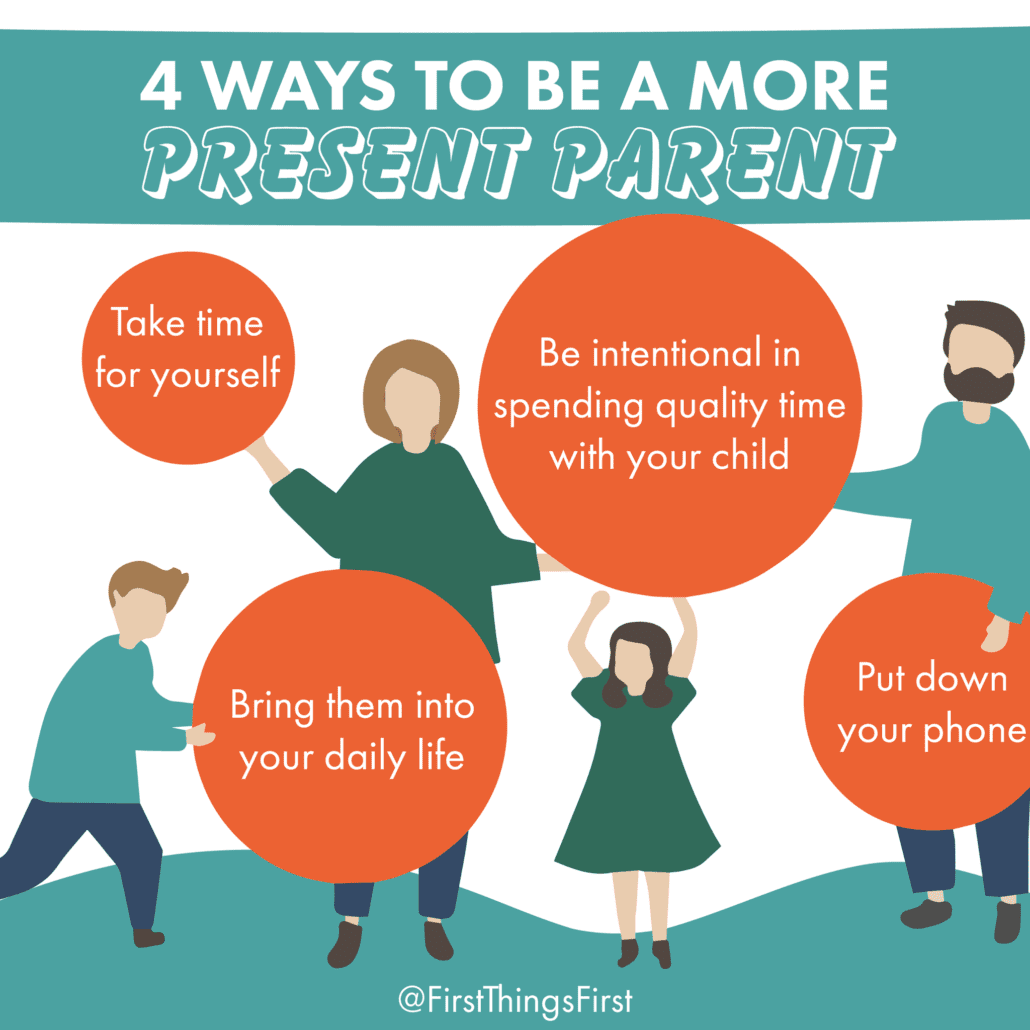
2. Be intentional in spending quality time with your child.
Whether it is when they wake up or during your bedtime routine, create space for intentional and focused time with your child. Quality time doesn’t have to be a big planned activity. It’s really the little sweet moments that matter like telling your child you love them, placing a note in their lunch box, playing with them, or reading to them. As they grow, allow them to read to you, have a snack together, tell silly jokes. It can be easy to start with 5 to 10 minutes, then work up from there. When you are intentional with spending quality time with your child it increases the bond between the two of you.
Things You Can Do First Thing In The Morning To Be a More Present Parent:
- Lovingly rouse them from sleep.
- Wake them by singing a good morning song.
- Cuddle in the bed with them.
- Ask them what are they looking forward to today.
Things You Can Do At Bedtime To Be a More Present Parent:
- Read them a book.
- Ask them about the highs and lows of their day.
- Give them backrubs and back scratches.
- Snuggle up with them.
Your child will begin to look forward to and anticipate the time that you will spend together. Try for quantity time and quality time and mind your mindset while you are with your child. Make sure all of you is present.
3. Take time for yourself.
If your tank is empty you have nothing to give and won’t be present. As parents, we have been told that our lives should revolve around our kids. Parents feel like it is selfish to take care of themselves. It’s really not. When you take care of yourself, you are creating greater capacity to give your energy to be with your child. Taking time to get enough sleep, eating right, exercising (running, yoga, biking, walking, hiking), or writing in a journal, all help put you in the right frame of mind to be an engaged and present parent.
4. Bring them into your daily life.
There are many parts of our lives that we can incorporate our children into.
Exercise: If you walk, run, or bike, get a baby carrier and take them with you. Put them in their stroller for a walk around the neighborhood or park. All the while, talk to them about what they see: the tall trees, the falling leaves, insects, and animals.
Cooking: Set up a small table for your child with child-sized utensils. Allow them to play with pots you’re not using. If your child is an infant, place them in their seat where they can see you. Cook while having a running conversation with your child. Talk to them about what you are doing. Ask them questions about their thoughts and feelings.
Work: If you are having to work from home with a young child, create a “workspace” for your new “assistant.” Give them paper, crayons, and washable markers as supplies.
Household Chores: Your child can sort clothes by color to place in the washing machine, take clothes out of the dryer, and carry clothes to the correct room. Give your child the responsibility to feed and water the family pets.
If you’ve been beating yourself up as a busy parent, STOP.
Kids aren’t looking for perfect parents; they are looking for present parents. Don’t allow the stress of “Am I doing enough?” hamper you from enjoying what you are doing. Spending quality time being present with your child should trump your feelings of guilt and stress about not spending enough time with a child.
In reality, working moms today are actually spending more time with their children than stay-at-home moms did in the 1970s. Father-child quality time together has almost tripled in that same time period. Please give yourself a break. Make the most of all the moments you have with your child. You can do it!
Is My Stress Level Affecting My Child?
Walk into a crowded room and ask for a show of hands from anyone who has not felt stressed-out in the past six months. If you find a hand-raiser, pull them aside, and ask their secret. My bet is not one hand will be raised. Truth is, we all experience stress at varying degrees, and many times it overwhelms and overtakes us. As parents, we have to ask the question, “Is my stress level affecting my child?”
The short answer is, yes… but there’s more to the story than that. Bear with me here.
LET’S EXPLORE STRESS
Most people think stress is bad, and we should do everything we can to eliminate it from our lives. The less stress, the better. I admit: I’ve thought this for many years. However, that’s not entirely true.
Let’s flip the script somewhat: Stress actually plays an important role in our lives. By definition, stress is the normal reaction the brain and body has when change occurs. You know about change: the boss assigns another project, the overdue bill arrives in the mail, the in-laws announce they’re coming for dinner (not that this would ever stress me out personally… in case anyone asks).
And we experience responses to stress in different ways: increased heart rate, heavier breathing, cloudy thinking, jitteriness, headaches, stomachaches… the list goes on.
Nevertheless, stress is vital. Without it, we couldn’t avoid dangerous situations, meet deadlines, or have a competitive edge.
- Our eyes wouldn’t dilate for a wider sight range to look for danger.
- Your breathing wouldn’t speed up, carrying oxygen to the brain for sharper mental acuity.
- And your heart rate wouldn’t increase, giving you a boost of energy to meet a particular challenge.
These are all good things. But here’s the kicker: our brains and bodies are only meant to experience these bouts of “good” stress for short periods of time, enough to work through whatever change is going on. Stress turns “bad” when we camp out in these responses for a prolonged period of time.
Our brains and bodies aren’t designed to handle this well. Matter of fact, our brain can actually restructure itself and function in a chronic state of stress. (Doesn’t that sound wonderful?) Have you ever met someone who seems on edge, stressed out, ready to snap? More than likely their brain has trained itself to stay in that “fight or flight” mode. And this has some terrible effects on body, mind, emotions, and relationships.
What this all boils down to is not whether or not you have stress (nor necessarily the level of stress, although that plays a part of it), but what you’re doing with your stress.
So back to the kids. Is your stress level affecting your child? Of course it does—and how it affects them depends on what you’re doing with the stress.
THE EFFECT OF PARENTAL STRESS ON CHILDREN
Ellen Galinsky, author of Mind In the Making and researcher at the Families and Work Institute, has shown that parental stress (or more accurately, parental distress) spills over onto our children. Galinsky’s research indicates children almost have a sixth sense when it comes to detecting parental distress. Maybe you’ve experienced this with your own kiddos. They pick up on the tension in your facial expressions and the worrisome tone of your voice. And the worst part is, children mimic your tension and behavior. If you are freaking out, even just on the inside, they are more prone to play monkey-see-monkey-do.
To further the point, University of Maryland researcher Nathan Fox and his colleagues looked into how parenting styles affect how children regulate emotions and deal with stress. An interesting finding of his showed that one of the least helpful characteristics were parents who are alarmists. These are parents who see danger everywhere and predict the worst-case scenarios in their minds. They make regular use of the phrases “You are going to hurt yourself” or “Be careful!” or “Please don’t fall!” These parents have worry written all over their faces and wear their distress like a bright orange caution vest for their children to see.
The big takeaway point here for parents is not Don’t Get Stressed; rather, parents need to model how to handle stress in healthy ways. In Galinsky’s words, “…you matter—and that includes how you convey stressful situations to your child.”
SO WHAT’S A (STRESSED) PARENT TO DO?
- Keep in the forefront of your parenting mind that the idea is not to eliminate stress, either from our own lives or that of our kids, but to learn to deal with distress in a healthy way. It’s very tempting to want to shield our children from the stressors of the world, but those stressors serve to bolster your child’s development. Megan Gunnar, researcher at the University of Minnesota and considered to be the foremost authority on stress and coping in children, says, “A childhood that had no stress in it would not prepare you for adulthood. If you never allow your child[ren] to exceed what they can do, how are they going to learn to manage adult life—where a lot of it is managing more than you thought you could manage?”
- Model healthy ways to cope with your own distress. One of Nathan Fox’s latest studies found that when parents have someone to turn to for support during stressful times, it has a positive effect on their children’s social development. The big lesson is, have a healthy support system available for you. And be sure to practice self-care. When you regularly do intentional acts of taking care of your mental, physical, and emotional health, not only are you mounting fortifications to guard against distress, you are also showing your kids how to build those same guardrails.
- When you are having a bad day when distress might be getting the best of you, use this as a learning opportunity for your children. Say something to your kids like, “Today doesn’t feel like a good day for me. Sometimes mommies and daddies have bad days when they feel worried about certain things. That’s okay—I know that everything is going to work out and that I don’t have to feel this way all the time. Here’s how I’m going to help myself feel better today…” And then, share with them how you’re going to work through the stress you’re feeling. Voila!—a stellar teachable moment.
- On stressful days, let your kids know that it isn’t their fault. Since children often do have that “sixth sense” to indicate when you’re feeling stressed out, it can be easy for them to feel responsible for it. Ensure them that sometimes bad days happen to both children and adults, it’s nothing they said or did, and we all have the power to overcome the feeling of being fearful, worried, or anxious.
One final thought:
If you’re married, do everything you can to handle marital conflict in a healthy, respectful way. We know from research that when handled poorly, parental conflict, is emotionally and physiologically traumatic for kids. John Medina, a developmental molecular biologist and researcher, tells us that even kids as young as six months can detect when unhealthy conflict is happening, and it has a negative impact on development. For some great information on how to handle marital conflict in healthy ways, take a look at this blog, this one, and this one, too.
So, does your stress level affect your child or not? Well, yes. But maybe the real question is, does how you handle stress have an effect on your kids? It certainly does, and the effect can be either positive or negative depending on how you’re handling it. Times of stress, those inevitable changes you experience that cause your brains and bodies to respond in certain ways present opportunities to teach your children valuable lessons for adulthood. Show your children the power they have to control stress rather than have stress control them. And it begins with you.
Image from Pexels.com
7 Tips For Getting Over A Bad Day With Your Kid
A few years ago I was walking through the grocery store when I encountered a mom and her toddler who was giving her a run for her money. As we were both walking down the aisle, I could hear her whispering, “You can do it, Susan! Hang in there. Just a few more minutes.”
At first I thought she was talking to her daughter, but then I realized she was encouraging herself in the midst of a hard moment with her child. I thought to myself, “You go girl!” I can remember plenty of hard moments, and just plain bad days with my daughter that I didn’t handle well. Even into a new day I found myself struggling to get over the bad day we had the day before.
Fortunately, I had some moms in my life who were further down the road in their parenting than I was. They didn’t judge me, which I am very thankful for. They did take me under their wing and offer some wise words to help me get over the bad days. Now, I’m passing their wisdom along to you, with a little of my own.
Realize that it’s not usually about you.
Believe me, I know it’s hard not to. When they act a fool in the checkout line or look straight at you and do exactly what you asked them not to do, it’s a challenge to remind yourself: it really isn’t about you. However, if you can train yourself to do this, it will be helpful.
Avoid beating yourself up.
We all have bad days, kids and parents alike. When your child is especially challenging, it can bring out the absolutely worst in us and it just goes downhill from there. The natural tendency hours later or the next day is to say, “If only I had…” or to question your ability to be a good parent. None of this is helpful to you or your child.
Acknowledge your emotions.
Listen, parenting isn’t a walk in the park. Tell me something I don’t know, right? Some stages are more challenging than others. I remember calling a friend after a particularly bad day with my daughter. I was crying, actually sobbing and I said, “I’m an utter and complete failure at parenting.” She point blankly said, “No, you are not a failure. You just haven’t figured out what works yet with your daughter.” Then she talked me down off the ledge.
There literally may be days where you are asking, “Where do I go to resign?” because you are angry, resentful, hopeless, and exhausted. Believe it or not, it’s very helpful to say those things out loud or to write them on a piece of paper.
Look for underlying issues.
For example, COVID-19 quarantine has had all of us out of sync from our normal routines. As adults, we can talk about how much we don’t like not knowing what tomorrow will bring. But for a child, especially a young child, while they pick up on your stress and anxiety, they aren’t able to verbalize it, so they act it out. Hence your very own child creating their own version of “Alexander and the Terrible, Horrible, No Good, Very Bad Day.” A death in the family, something happening to your dog, overhearing you fighting with your spouse—any number of things can bring on a bad day.
Seek to restore the relationship.
Once you have taken a moment (or a few hours) to calm down, find your child and apologize straight up. Don’t add on, “but if you had done what mommy asked…” Just apologize. “I’m sorry. Please forgive me.” You might say, “If that happens again, let’s do things differently,” and calmly talk through a better way to handle the behavior or the day. All of this models behavior you want your child to learn and the skills they need for healthy relationships.
Spend some time together doing something fun.
After apologizing and spending a little time talking about what happened, find a way to spend some calm, easygoing time together. Take a walk, play with blocks, read a book (The Color Monster: A Story about Emotions is a great read), play “I Spy” or make cookies together.
Never underestimate the power of a hug.
Adults and children alike need them, especially after a bad day. Even if you aren’t completely over the bad day, you still want to avoid withholding hugs. Loving, physical touch can be as healing as spoken words.
There will be days when you don’t like your child’s behavior or your own for that matter. However, don’t confuse not liking their behavior with not liking or loving them. Our children need to know that even on their very best or worst day, there isn’t anything they could do that would make us love them more or less.
For the most part, I am on the other side of the bad days. In the midst of them, I often questioned my Fit Mom Card, and I had a hard time believing there were better days ahead. In case nobody else is saying it to you—you are a good mom. Even on your worst day, you’re a good mom. Stop telling yourself otherwise. It’s a wild ride. We all have moments we want to forget. It is unlikely your child will hold your bad days against you, especially if you put into practice what we have talked about.
Image from FreePik.com
Seven Things Every Child Needs to Thrive
Does it seem like everyone has something to say about how you’re parenting?
Do you question whether or not you’re doing the right thing for your child?
Do you want assurance that you’re meeting your child’s needs?
Researchers and practitioners have sought for years to find what children need to thrive in a variety of ways—physically, mentally, psychologically, emotionally and behaviorally. The research is in. They might use a different word or two, but we have a good idea about what children need to thrive. Relationship is everything.
Dr. Mark Laaser and his wife, Debra Laaser, LMFT, have worked with individuals and couples for many years. Through their work, they found that in relationships, we all have desires in our hearts. Those desires begin in childhood and last throughout our lives.
1. To be heard and understood.
Your child needs you to hear and listen to them, even when what they say is difficult to hear. If they don’t feel heard, they will either stop talking or begin to over-talk you.
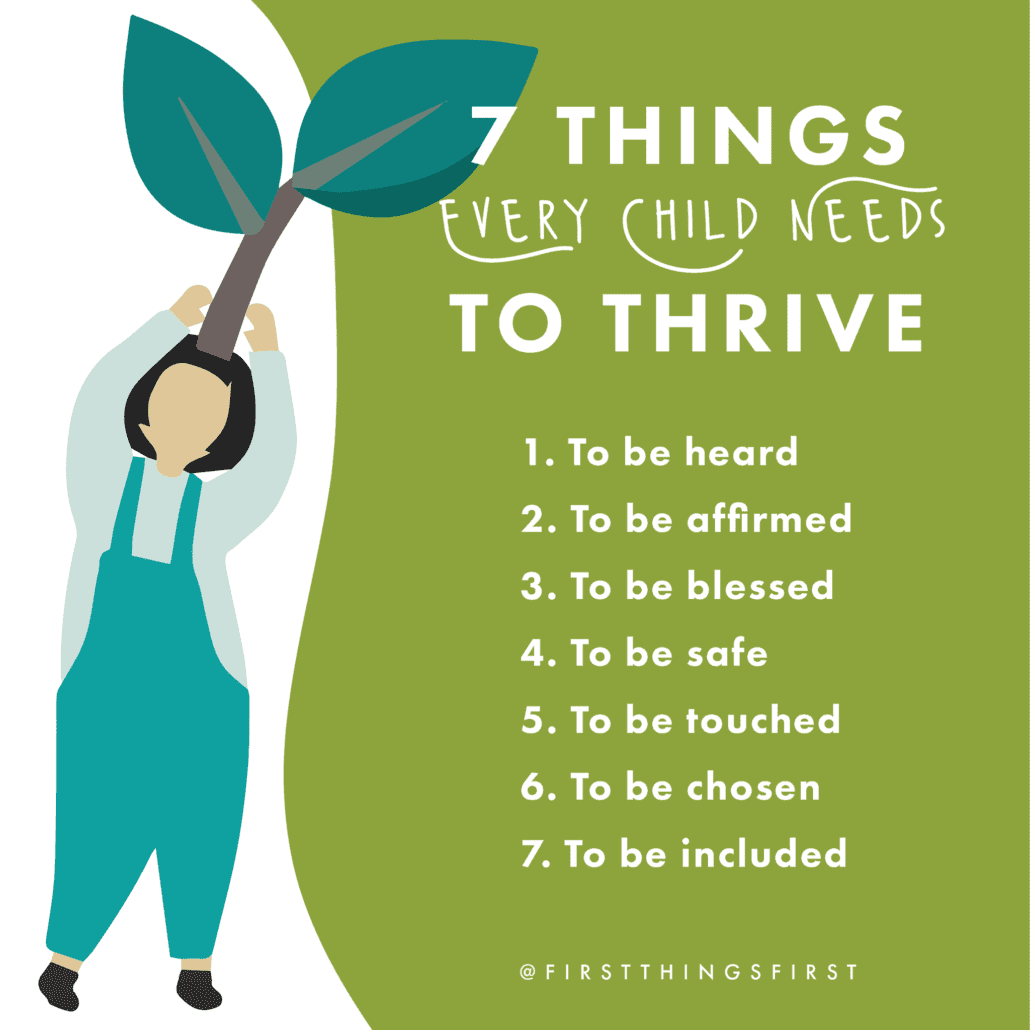
2. To be affirmed.
Your child desires for you to recognize what they do. Whether for academics, arts, or athletics, you showing up means a great deal to your child. They may win or just participate, but your acknowledgment that they did a good job can make their little hearts happy. When they complete a task or chore, saying thank you (even if they don’t do it the way that you do it) is an additional way to notice their contribution to the family.
3. To be blessed.
Your child desires to know that you love them unconditionally for who they are not for what they do or accomplish. No matter how they behave (temper tantrums), how successful they are in athletics or not, how well they do academically or not, your child needs to feel your love and support.
4. To be safe.
Your child desires to feel safe, free from extraordinary fear, worry, and anxiety. There are conditions that parents can’t control such as a global pandemic or natural disasters (tornado, hurricanes, fires). What you can do is ASSURE your child that you are right there with them. Being aware of your feelings will help you handle those of your child.
5. To be touched.
Your child needs and desires physical contact. As infants, children who don’t receive physical touch often get a diagnosis of “failure to thrive.” According to Dr. Virginia Satir, “We need four hugs a day for survival. We need eight hugs a day for maintenance. And we need twelve hugs a day for growth.”
6. To be Chosen.
Your child desires to know that you want and cherish them as a member of the family. In my house, my sons often ask, “Who is your favorite child?” The truth is each one is my favorite child. Our family would not be the same if any of them were not a part of it. Likewise, your family would not be the same if any of your children were not a part of your family.
7. To be included.
Your child desires to know that as a member of your family, they matter, belong, and have significance. Find ways (age-appropriate) to include them in decisions (what’s for dinner, family outings). Not only is their presence necessary, but their contribution to the family ideals and expectations is mandatory.
Parents want the best for their children through experiences and exposure. There will be times that you miss the mark as a parent. Your child may not make every team or production they try out for. You may get angry and raise your voice. Remember that what your child needs to thrive is for you to be an engaged (not perfect) parent who is seeking to meet the needs and desires of your child’s heart. There are probably a few things that you’re already doing, but if you see one that you’re not, choose one to focus on this week.
Other Lists Of What Children Need