
Tag Archive for: Marriage Help

There are not many feelings worse than when someone puts you down, insults you, or invalidates you. And a put-down from your own spouse is like a straight-up punch to the psyche. It’s amazing how easy it is to hurt the ones we love the most with our words, but what do you do if you are the one on the receiving end of the verbal blows? 

This issue has a certain level of complexity to it, which means we have to approach it with care. Many spouses deliver verbal shots and put-downs to their spouse, unaware of the harm it’s doing. This is Situation A. 

Others are well aware and intentional with the harm. This is Situation B, and this is abuse.  

Let me be clear about Situation B right off the bat: If you are experiencing an abusive situation where someone is physically harming you, you need to seek help. Use the hotline number at the bottom of this article. 

You also need to understand that certain situations of verbal/emotional put-downs may be verbal abuse, and often accompany (or are a precursor to) physical abuse. (See the Power and Control Wheel below.)

Healthline gives some red flags to the characteristics of verbal abuse: 

  • They insult you or attempt to humiliate you, but then they accuse you of being overly-sensitive. 
  • They yell or scream at you frequently. 
  • The person plays the victim while they try to make you feel guilty. (“I wouldn’t have to scream at you if you didn’t…”)
  • They get in your personal space as an act of intimidation or try to block you from moving away.
  • They gaslight you—this means they manipulate you into questioning your own version of events in order to gain more power. For example, they may convince you to doubt your memory of them saying or doing something violent or try to convince you you’re crazy.
  • They hit the wall or throw things.  
  • They want credit for not having hit you. 
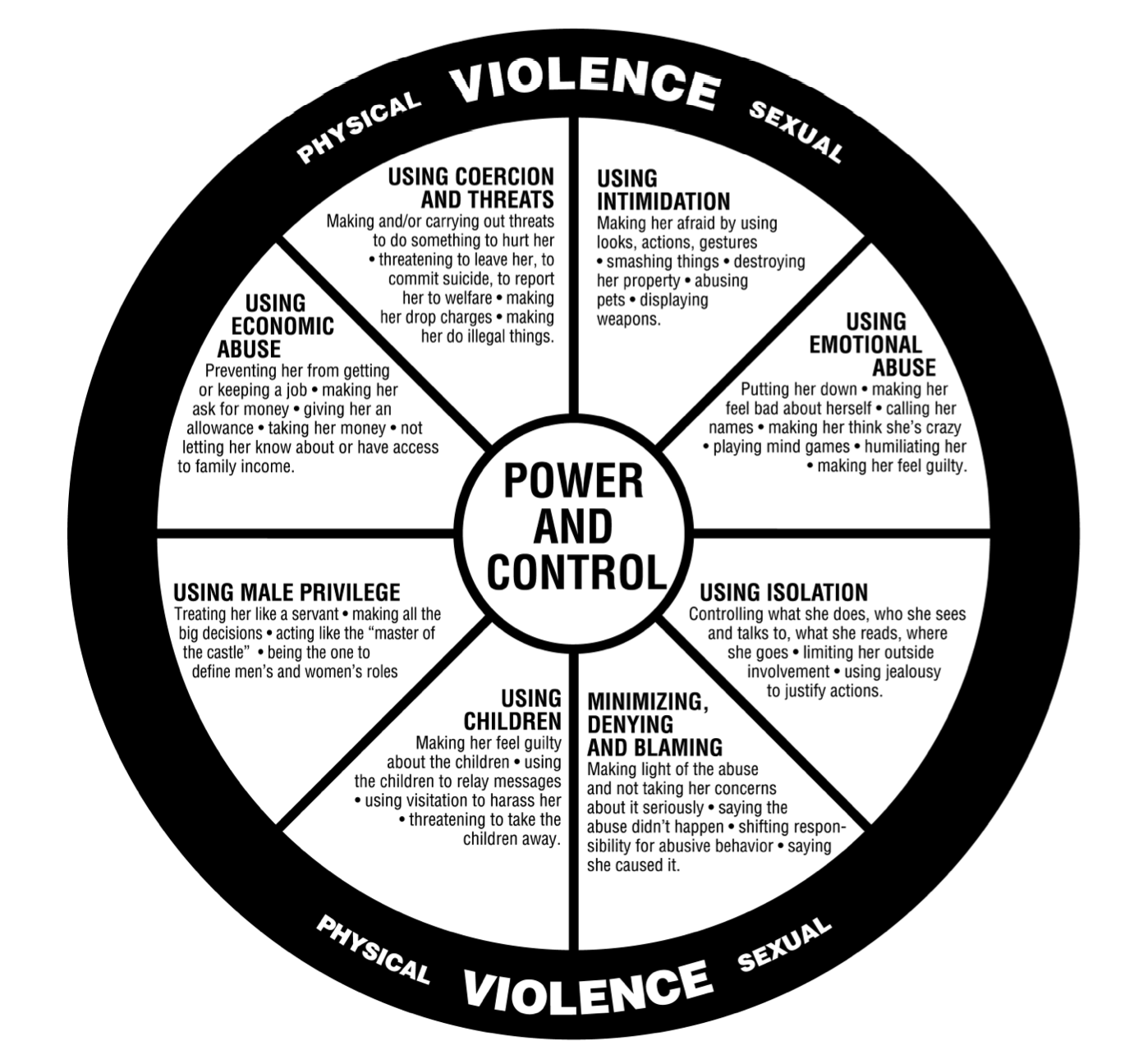
Sincerely ask yourself the following questions:

  • Do I believe my spouse is putting me down with the intention to harm me, wear me down, or manipulate me?
  • Do I think there is a possibility the verbal attacks could lead to physical violence?
  • If I were to voice my concerns for how they talk to me, is there any fear that they would react with a heated backlash? 

Unless you can answer each of these questions with a confident no, these are strong indicators of verbal/emotional abuse and warning signals for possible physical abuse. Do not confront your spouse. Go somewhere safe and seek help. 

Let’s talk about Situation A.

Your spouse puts you down but they are unaware of how it’s making you feel. They are being careless with the words they use toward you—perhaps in front of the kids. But despite the unintentionality of what they say, you still feel devalued. It’s time to let them know how you feel. 

  • Approach your spouse to talk at a strategic time. Ask them if this is a good time to talk. And if it’s not, arrange a time, preferably within the next 24 hours. Don’t bring up your feelings right after they say something hateful; your emotions will be dialed up, and you want to be calm and able to think clearly when you talk. Choose a time when neither of you are tired or in a bad mood. 
  • Start on a good note. Marriage researcher Dr. John Gottman suggests opening difficult conversations with a positive. Begin the conversation with something you appreciate about your spouse. Say something like, “I know that you love me and the kids and that you’d do anything for your family.” Or, “I appreciate how hard you work to provide and take care of us.” 
  • Be specific about what you hear and how you feel. Make good use of “I” messages. For instance, “There have been many times when I’ve felt really undervalued and unloved when you’ve said certain things to me.” Name your feelings—beforehand, jot down some specific words that describe how it feels when your spouse puts you down. If it happens in front of your kids or other people, point out that it feels embarrassing or shameful. Err on the assumption that your spouse has been unaware of how they’ve made you feel. You may have to give them an example of what they’ve said. Describe the last incident and the effect it had on you. Avoid giving a laundry list of all the past wrongs they’ve done to you, though. 
  • Use a code word or sign. The point of addressing this with your spouse is help them be aware that they are putting you down and the negative effect it has on your feelings. Establishing some kind of code word or a non-verbal signal can subtly express to them, “You’re being degrading and ridiculing right now, and you need to dial it down.” This is especially helpful in front of the kids or in social situations. For instance, whenever you respond with “Oh, honey…” or you nonchalantly touch your earlobe, you can discreetly and calmly express to your spouse how they’re making you feel at the moment. 
  • Set boundaries. Let your spouse know that if they continue to ignore warning signs and keep putting you down, you’ll simply leave the room when they say something disparaging. Don’t threaten your spouse with divorce or the withdrawal of sex (although you probably won’t exactly feel “in the mood” after being put down). You set up boundaries to protect yourself, not punish others. 
  • Check your own thoughts and words. I mention this last step with a great deal of care, and I encourage you to approach it with humility and thoughtfulness. I have talked with many individuals who have felt insulted by others close to them; however, sometimes there was something within their own personality that colored the situation. Many were highly sensitive to remarks that weren’t overtly insulting, but they heard them through the filter of past negative experiences. 

For instance, one person interpreted an invitation to exercise together as an affront to their weight, an issue to which they felt particularly sensitive. Others that I’ve talked to were offended by another’s insults, but had no problem being equally insulting toward that person. Part of the process of working through this is to consider what may be going on inside you that could exacerbate these feelings. Ask yourself: Are the words I hear from my spouse truly insensitive put-downs, or is there something inside me that makes me overly-sensitive to their words? And, are there ways that I put my spouse down without me noticing it? 

Marriage cannot thrive in an environment of disrespect and insults. And no one deserves to be put down by their spouse. The above steps are a process that may take time before you see real change. There’s a chance that other things are going on under the surface of insults and put-downs being hurled your direction. If these problems persist after taking the above steps, ask your spouse to seek help with you through couples counseling. If they resist, seek professional help on your own. ☆ Sometimes it takes one person in the marriage to lead the charge toward getting help and improving the relationship before the other catches on. 

***If you or someone you know is in an abusive relationship, contact the National Hotline for Domestic Abuse. At this link, you can access a private chat with someone who can help you 24/7. If you fear that someone is monitoring your computer or device, call the hotline 24/7 at: 1−800−799−7233. For a clear understanding of what defines an abusive relationship, click here.***
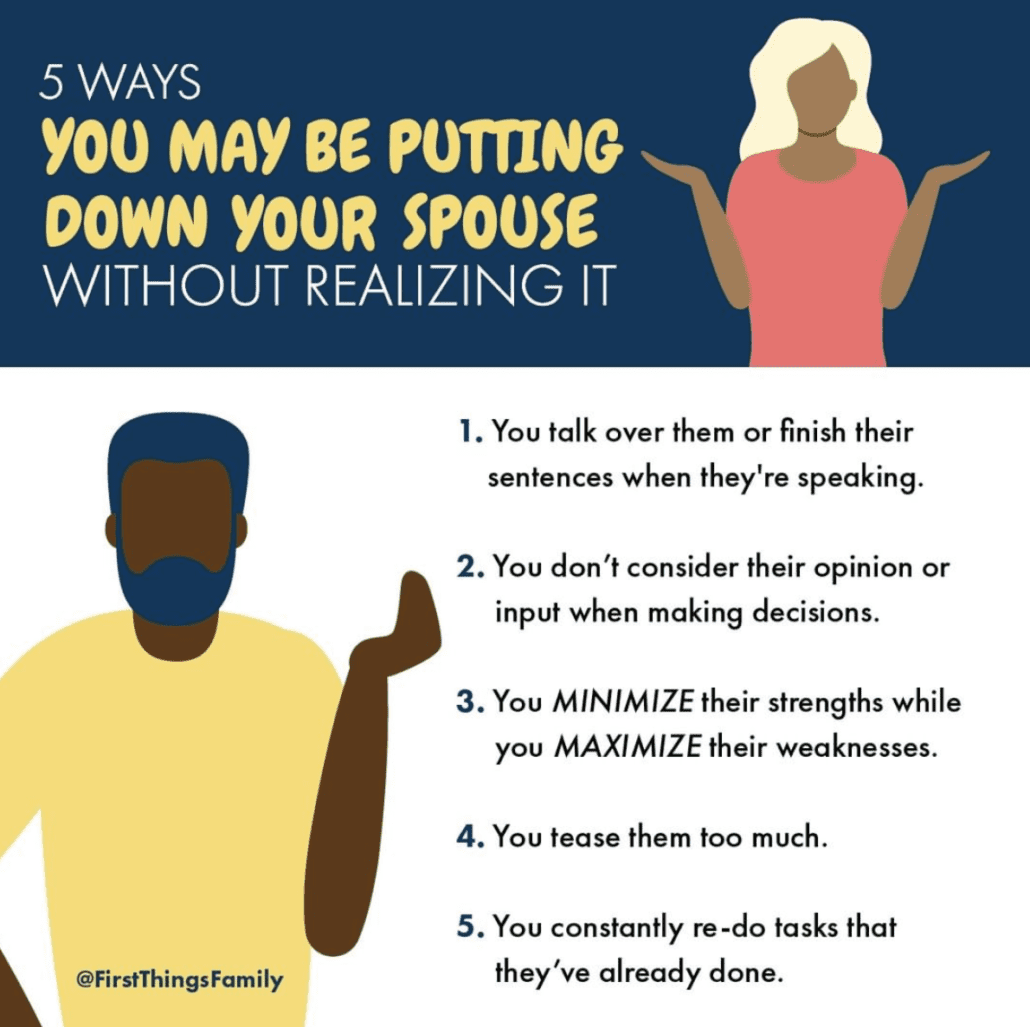

Image from Pexels.com

5 Ways You May Be Putting Down Your Spouse

These things undermine your relationship.

Have you ever made a joke about your spouse and they didn’t think that it was funny?

Has your spouse ever remarked on a “weakness” of yours and you felt some way about it?

Has your spouse ever made fun of you or put you down in front of your kids?

What are some of the common ways that we unwittingly put our spouses down?

1. You talk over or finish their statements when they are speaking.

It can easily become a habit to talk over your spouse or finish their statements for them. When you do this, you are sending the message to your spouse that you don’t respect their perspective and opinion. Additionally, this can minimize them in the eyes of others (family, friends, co-workers, children). 

2. You don’t consider/obtain their opinion or input when making decisions  (i.e., the kids, family vacations, or future plans).

Teamwork is important in marriage. It takes both parts of the couple contributing to make it as strong as possible. When one person makes all the decisions, it can lead to a myopic view of the situation. Having differing options and opinions can strengthen a plan. Like a well-woven tapestry, considering and respecting the input from your spouse creates a better and holistic problem-solving strategy.

3. You MINIMIZE their strengths while you MAXIMIZE their weaknesses.

When couples get together, they often say, “Where I am weak, my spouse is strong and vice versa.” After a time, it can become problematic when the focus changes to, “I really can’t believe that my spouse can’t do that.” For example: you may be very strong at directions while your spouse needs GPS to go anywhere, even places that they have been many times before. Sitting in the car as they set up the GPS, you think, “OMG, I should have just driven. They never know how to get anywhere.” You then share with anyone who will listen that your spouse is seriously DIRECTIONALLY CHALLENGED. From there you only seem to notice their deficiencies rather than their strengths.

4. You tease your spouse too much.

Whether it is about their hair, nose or the way they eat spaghetti, teasing your spouse can be a way to bring humor to your relationship. However, too much of a GOOD THING can become a problem. If you seem to nit-pick everything about your spouse even with a hint of levity, they may feel undervalued. Find ways to build up your spouse, not tear them down—even in JEST.

5. You constantly re-do tasks that your spouse has already done.

For many spouses, there are two ways to do things: MY WAY (THE RIGHT WAY) and your way. Your spouse may feel belittled as you refold the towel, remake the bed or reload the dishwasher. You inadvertently are telling them that their efforts are not wanted, needed, or appreciated. Because only YOU can do it, the RIGHT WAY.

Zig Ziglar said, “The first step to solving a problem is to recognize that it does exist.” Recognizing that you may be putting down your spouse is the initial step. While your spouse does things differently than you or even parents differently than you, it is KEY to respect those differences. Making fun of them or negating the importance of your spouse in your life and in the lives of your children undermines your relationship. Remember that the two of you are a TEAM. 

✦ Each of you has a role to play to make your family the BEST that it CAN BE!

***If you or someone you know is in an abusive relationship, contact the National Hotline for Domestic Abuse. At this link, you can access a private chat with someone who can help you 24/7. If you fear your computer or device is being monitored, call the hotline 24/7 at: 1−800−799−7233. For a clear understanding of what defines an abusive relationship, click here.***

Image from Pexels.com

4 Reasons Why Respect Matters In Marriage

Hint: It plays a critical part in a healthy marriage.

Respect matters in marriage. 

Maybe more than anything else. 

And I’m going to tell you why. 

Respect may best be defined as the way you show true appreciation for another person. Respect is an action, not just a feeling. It’s a declaration of value for someone. We demonstrate respect by how we behave toward another person. 

And it’s fairly easy to recognize when someone respects (or disrespects) another person. 

The show of respect is usually thought of as coming from a place of inferiority. Pictures come to mind of soldiers standing at attention when high-ranking officers enter the room, or of hard-working employees speaking highly of their boss. 

Respect in a healthy marriage is different, though. It’s a two-way street. Both parties in the relationship crave and deserve equal respect from the other, and rightly so. Respect is shown in marriage not because one person is more superior than the other, but because each person recognizes the value of the other. 

In marriage, mutual respect matters. 

But why? Why does mutual respect play such a critical part in a healthy marriage? 

Here are four reasons: 

  • Mutual respect eliminates the fear of being different. Let me explain. In your marriage, you and your partner each come to the relationship as individuals. You have your own personality traits, talents, quirks, past experiences, and interests. Showing mutual respect demonstrates an appreciation for each other—differences and all. Your respect toward your spouse gives value to the differences they bring to the relationship. When mutual respect is given, it opens up a vulnerability for each person to be who they are without the fear of being devalued or judged unfairly
  • Mutual respect upholds healthy boundaries in the relationship. Even the healthiest marriages reinforce proper boundaries. When you show respect—appreciation for your spouse, you recognize certain needs. For example, I’m the kind of person who really has to have some time alone each day just to recharge. My wife respects that (even though she doesn’t have the same need), and so she knows when to give me some space. It’s important to my wife that there’s no name-calling between us, even if it’s in jest (because often things can go too far or easily be misinterpreted). I try to respect that, even though playful name-calling was a part of my upbringing. Mutual respect gives strength to uphold these boundaries. 
  • Mutual respect compels you to “check your jersey” when you have disagreements. I love this phrase (which I borrowed from Kyle Benson, a blogger for The Gottman Institute). In the heat of a conflict, it can be easy to fall into the false notion that your spouse is working against you in this team effort called marriage. Respect doesn’t take away the chances that disagreements will happen; they will, even in the best of marriages. But when you practice mutual respect in marriage—and practice it often—you are more confident that, despite the conflict, you know you and your spouse are on the same team and working toward the same thing. You can see more clearly that you’re wearing the same jersey. 
  • Mutual respect strengthens the friendship between you and your spouse. Relationship researcher John Gottman says that long-term vitality and connection is grown through intentional friendship in your marriage. In other words, marriage is healthy when you and your spouse deepen your friendship. Because it shows appreciation and value for your partner, showing mutual respect provides the space for friendship to grow. Why? Because it takes the fear of vulnerability out of the equation. My wife is my best friend because it’s with her that I can be the most vulnerable. That can’t happen without mutual respect. 

But wait… there’s more! 

BONUS REASON why mutual respect matters in marriage!

  • Mutual respect needs to be modeled to children. If you and your spouse are parents, no doubt you want to raise them to be respectful adults. A child’s primary source for lessons on respect come from watching how their parents behave toward each other. My wife and I have two daughters, and I think it’s important for them to understand how husbands and wives should treat each other—with warmth, care and respect. Hopefully, they can see that in us. Mutual respect in a marriage is essential for teaching kids to be respectful

Mutual respect matters in your marriage.  🔎 Find the ways to appreciate your spouse—differences and all—and show that appreciation on a daily basis. Declare your spouse’s value in your actions. You’ll be better friends, better parents, and better teammates

***If you or someone you know is in an abusive relationship, contact the National Hotline for Domestic Abuse. At this link, you can access a private chat with someone who can help you 24/7. If you fear your computer or device is being monitored, call the hotline 24/7 at: 1−800−799−7233. For a clear understanding of what defines an abusive relationship, click here.***

Image from Unsplash.com

I have good news and bad news if you disagree about parenting. First, the bad news. Marriage researcher, therapist, and author, Dr. John Gottman has found that there are several issues couples will NEVER 100% agree on. Parenting is one of them. One of you is probably all about tough love while the other is more permissive. Maybe one of you is all about the bedtime while the other is a little more lax in that area. Or perhaps one of you makes them eat everything on their plate while the other gives them more options on what they eat. 

It’s been that way since you’ve had kids and it’s probably not going to change.

Now, for the good news. Your child needs both of you—differences and all. When a couple learns how to work together through their differences, the marriage is stronger. Just as importantly, your children are better off for it. Kids need stable, loving parents—not perfect ones that agree on everything.

I know that sounds good and all. But how does that work? Let me say that I understand your challenges. My wife and I are the proud parents of seven kids and we couldn’t be more different in our approach to parenting. She’s more black and white when it comes to discipline. Actions lead to consequences. I’m the, “Let’s talk this through and understand it better” parent. She’s the parent who wants the four oldest kids to clean the kitchen together so they learn how to work with each other. I’m the divide and conquer. Two of you clean today and two of you clean tomorrow because I don’t want to hear fussing and arguing.

When my oldest daughter doesn’t tell the truth about something (I’m sure that’s a surprise that a 13-year-old doesn’t always tell the truth), often our instinctive approach is very different from one another. 

Why is it so important that you recognize the differences?

  • Marital Tension: Your different approaches, at times, cause dissension within your marriage. You can feel like your spouse is either too hard, too lenient, too strict, too passive, too trusting, or too controlling. Tension also may grow when you feel like your spouse is not supportive of your parenting efforts.
  • Leads to children manipulating parents: Children can pick up on division. And they will feed off of it to get their way. (We’ve seen that happen a few times.)
  • Division: Families are meant to be a unit. When couples do not learn how to work together as parents, it can lead to division within the family—and that is unhealthy for everyone.
  • Poor Training of Children and Confusion: Kids don’t know boundaries, expectations, or structure. It becomes more difficult for them to learn right from wrong.

How do couples manage parenting when they disagree?

Discuss differences behind closed doors: Children don’t need to hear you disagree about parenting, how to discipline, what activities to participate in, where to allow the kids to go, etc. Amy McCready, the founder of Positive Parenting Solutions, says that 95% of issues don’t have to be solved on the spot. Don’t feel pressured to solve everything immediately. Become adept at saying, “Your (mother) and I will discuss this and let you know.

Don’t throw the other parent under the bus: Avoid statements like, “I think that’s a good idea. Let me check with your mother.” Now she’s the bad guy if in fact you decide it’s not a good idea. “We would, but your father doesn’t like that kind of thing.” Or, “You know your mom wouldn’t go for that.

Sincerely talk with one another from a team perspective: Figuring out how to work together is powerful. Listen and understand one another. Often you can meet in the middle. Sometimes you may lean more toward one spouse’s perspective or the other. Sometimes you can end up doing both. My wife and I have learned that I can generally get my children to acknowledge where they’ve gone wrong and how to correct it. And I’ve learned that without the consequences that she’s encouraging us to enforce, they are more likely to repeat the same behavior. We’ve often gotten the best of both worlds.

Present a united front: Once the two of you can agree on a parenting choice about an issue, then be on board with the plan, even if it wasn’t exactly the one you wanted. Make it your goal that the kids never know whose idea it was in the first place. I love it when my kids think a consequence was their mom’s idea, but really it was mine, not because I want them to think she’s the bad guy. Our goal is to show them we’re a team, not a team against the kids, but a parenting team working in the best interest of our family.

Don’t be afraid of making a “wrong” decision: It happens. There’ve been times we’ve come down too hard and times we were too lenient. There were times where we allowed them to participate in something that in hindsight was not the best decision. And what’s worse is that my wife and I disagreed on the front end and we chose the wrong path. Our children were not ruined for life because of our bad decision. Don’t forget, the best gift we can give them is a stable, committed relationship. Perfection is not part of the definition

Seek input from parents you trust: Find couples with similar values whose children are in the next phase your children are moving toward and pick their brain. Ask them about their parenting differences and how they’ve made it work. 

Support your spouse in their absence: Michele Weiner-Davis, best selling author and marriage therapist tells a story of undermining her husband’s parenting authority by disciplining and parenting her children over the phone when their father was home with them and she did not think he was doing what she thought was right. She learned that this was not healthy for her children, their father, or their marriage. She realized that it was healthier for her to truly trust and leave the parenting to her husband when she was out of town and to support his decisions. When she came to that realization, the next time a child called her for parenting when dad was home with them, she let them know that she supported whatever decision dad chose

➤➤There are parenting decisions that your spouse will have to make that are different than what you’d do. 🔎 Before criticizing your spouse’s decision, ask yourself this question: “Do I believe he wants what is best for our children?” More times than not, the answer is yes. Show your spouse you believe in them as a parent.

✰ Conclusion: Different is not deficient.

It’s just different. What I hope you both do agree about is that you both love your children and want the best for them. The relationship skills your child learns from watching the two of you parent in the midst of disagreements may just be more powerful than if you agreed on every single thing. 

Yes, your kids will pick up on the parental differences regardless of how united a front you present. The strength in the marriage is that the differences do not divide you. The security for your children that you provide by parenting them through the differences will serve them well years after they are grown and gone, living out the principles you’ve taught them.

**Please note that this article is NOT about an abusive or neglectful parent. The physical and emotional safety of a child is not a difference in parenting styles. Anyone who knows of child abuse happening should call the National Child Abuse Hotline at 1-800-4-A-CHILD (1-800-422-4453).**

Image from Unsplash.com

If you have ever watched Everybody Loves Raymond, you know firsthand how overbearing in-laws like Ray’s mom can be. Giving her opinion when nobody asked for it, making off-handed comments about their parenting, criticizing decisions they make, and talking about them to each other was Marie’s style for sure. And, Raymond found it really hard to stand up to his mom, and we all know how that impacted their marriage. [Cue: Laugh Track]

Funny how so many have said they could truly identify with much of what happened on that show because they felt like they lived it every day. While some can kind of laugh it off, plenty of other couples find themselves actually having conversations about divorce because while they still love each other, they cannot figure out how to get one or both sets of parents out of their business. That’s NOT funny. Can you relate?

If you believe it is truly unhealthy for your family to be around your in-laws, your first responsibility is to your spouse. If being around your in-laws creates safety issues or requires you to put your family in an unhealthy situation—setting limits or creating boundaries is completely appropriate. Sometimes it may be necessary to make the decision that it’s in the best interest of your family not to be around your in-laws for a period of time. ★ 

If you feel like your in-laws are all up in your business, but it isn’t unsafe to be around them, the good news is, you’ve got options. You can:

  • Limit the amount of time you spend with them.
  • Plan ahead for how you will handle a visit that goes south.

Great! Got that part! But please tell me strategies for building a protective perimeter around my marriage!

Okay—here you go!

1. Your Marriage Is The Primary Relationship.

You both have to be intentional about making your marital relationship first. Marital distress may occur if one spouse doesn’t want to hurt his/her parents’ feelings and doesn’t see how them “investing” in your marriage is harmful. The two of you are a family and on the same team. Each person is responsible for communicating with their own parents in a way that does not throw your spouse under the bus. So, “We aren’t coming to your house this weekend because he doesn’t want to come,” is not an option on the table. Ever.

2. Stop Anticipating And Start Planning.

When you rehearse conversations in your brain, it actually gets you revved up. Stop playing it through in your mind how you think your in-laws are going to react or respond. Instead, discuss with your spouse how you want to approach or avoid certain topics. In essence, you are creating a strategy to help you both engage them and avoid being triggered by them. Make your plan together with your spouse. It may take a minute to get on the same page about how to move forward. It’s vital at this point however to remember that your spouse comes first, not your parents.

Here’s a side note worth mentioning: Before you and your spouse talk, spend some time thinking about where the angst with your in-laws is the most intense. 

  • Are they interfering with your marriage? 
  • Are they interfering with your parenting? 
  • Do they say things that hurt your feelings or rub you the wrong way? 

This is important to know in order to make a plan to help you move forward constructively.

3. Decide How You Will Respond.

Straight out of the gates, make a commitment to respond versus react. Every time you react to a situation, you are giving over power and control. When you respond, you are calm, think before you speak, take the time to get with your spouse and discuss feelings and opinions and then share your response with your in-laws. Think through the typical scenarios that tend to take place and decide what your response will be.

If something out of the ordinary happens and you aren’t sure what to do, you are probably better off taking a moment to breathe. Maybe even take a walk around the block with your spouse to decide the best plan of action. People often regret flying off the handle, but rarely regret an intentional, constructive response. Before you say a word, ask yourself, “Will my response build up or further tear down the relationship?

4. Set Appropriate Boundaries.

As a couple, it is important to have clear rules of engagement with extended family. When you are being clear with established boundaries, you are choosing your marriage, not between your spouse and parent. 

Examples of this could include:

  • We will call before we come to visit and we are asking you to do the same.
  • Yes, we have given you a key to the house in the event of an emergency, but we are asking you not to use it unless there is actually an emergency.
  • If we ask for your thoughts about our parenting style, please share your wisdom with us. Otherwise, we are not looking for unsolicited advice.

But what about power struggles? For real!

The best thing you can do is seek to avoid them. That sounds easier said than done, but if you and your spouse are on the same page, there shouldn’t be “power” up for grabs.

⇨ Don’t underestimate the power of a positive attitude. I know it’s hard. Dig deep. ⇦

➤ Remember, they are family. No matter the conflict, they are part of your family. Be aware of the level of tension, tones of voice, and language choice. All of these things can and will impact your children (their grandchildren). Are there behaviors you can choose to ignore? Give the benefit of the doubt? Extend grace? Ask yourselves, “Is this really worth ruining the relationship over?”

➤ Don’t assume they are intentionally trying to be difficult. In many instances, people think they are being helpful. They don’t realize that dropping by unannounced or giving unsolicited marital or parenting advice is not appreciated. Get with your spouse and brainstorm things that your in-laws could do that would be helpful. Then sit down with your in-laws and talk about what you would appreciate them doing. Also, discuss things that you would like them to stop.

➤ Relationships change and evolve. Believe it or not, many couples have been in exactly the same place you are at the moment. Through some advance planning, agreement on changes that need to be made, and strategic conversations, they now have a healthy and respectful relationship with the in-laws. It may take a minute, along with some tears and hard conversations, but don’t give up.

Image from AdobeStock.com

Are you feeling frustrated with your spouse?

Do things just seem more intense between the two of you?

Is working from home and/or taking care of the family making you tired? 

Are you worn out from keeping up with the household duties? 

Do you find that you and your spouse are arguing and disagreeing more?

Are differences being exposed as a result of COVID-19 and social unrest?

Do you sometimes lie in bed and wonder if you married the right person?

Before we dig into this, I want to be clear that if you are in a relationship where someone is abusing you in any way, stop here and seek help.*

As you went through the list above, you may have answered yes to some or all of the questions. These are trying times for sure. Right now, I want to focus on the last question.

Have you caught yourself entertaining the question: Did I marry the right person? 

When we experience challenges that exist for an extended period of time, it can bring out the best and the worst in all of us. Before you fully convince yourself that everything is your spouse’s fault, here’s something to consider. Everybody has been under extra pressure for the last 106-plus days and as a result, may be acting a bit extra. That being said, it’s important to recognize that most marriages go through challenging times. 

Although throwing in the towel may sound tempting, it might be helpful to set the wheels in motion to have a constructive conversation with your spouse about your marriage and how to ride these waves together. 

Here are some things to think about as you prepare for the conversation.

What exactly is making you question whether or not you married the right person? Sometimes we entertain thoughts but have nothing of substance to back them up. Try to nail down where this idea is coming from.

Then ask yourself, based on history in your marriage, is this narrative something that has recently come up or has it been ongoing for an extended period of time, as in long before COVID-19 hit?

Does your spouse know you are having these thoughts? If you shared what you are thinking today, would they be blindsided?

Here’s the thing: When you start getting irritated with your spouse, you can actually teach your brain to only see the things that get on your nerves or irritate you about them. And, the more you go there, the more you tell yourself your thoughts are justified and accurate. It’s kind of like confirmation bias. This can be very misleading and has caused plenty of people to call it quits on a perfectly good marriage.

Talk It Out

★ Maybe you are not feeling valued or heard. Or, you just don’t feel connected anymore and are bored. Instead of deciding that you are finished, find a time where both of you can sit and have a conversation away from distractions. Beware of telling them all the things they aren’t doing—instead, talk about how you are feeling and ask for what you need. 

“I need help with the children.”

“I’m feeling very distant from you. I would like for us to spend time together.”

“I’m scared about all that is going on.”

“I don’t feel appreciated or respected. Can we talk about that?”

“I am bored.”

Lead-ins like this are more likely to take you to a conversation instead of a meltdown because someone feels attacked. It’s totally possible that your spouse has no idea you are feeling like this and that they would be willing to do some things differently. (It’s also possible that your spouse is struggling, too.)

[Pause right here and take a deep breath.]

Instead of thinking your marriage might be coming to an end because you are questioning whether or not you married the right person, this could be the beginning of breathing new life into your relationship.

All marriages go through hard times. Talk with anybody who has been married any length of time and they will tell you, it was the times when they were hanging on to each other in the midst of the storm that brought them to the other side stronger and more energized. 

Here’s the other secret: many couples have learned that there are times when they don’t like each other very much or the strong romantic passion toward each other ebbs and flows. The key is, their commitment to their relationship remains strong. And, as they continue to put one foot in front of the other, things transition—like children get older, COVID-19 calms down, work gets less intense, children are back in school, everybody is healthy, and more.

Problems and difficulties occur in ALL marital relationships. Your marriage can thrive when you respect, recognize, and appreciate what you each bring to your marriage. When you look back over your relationship, you may actually see that you have had many more good times than bad times. Be aware that we all are experiencing unique situations that we have never faced. 

You might really be really asking yourself, “Did I marry the right person?” In reality, there are so many questions you are probably trying to answer right now. Give each other space and time to express and deal with the stress and anxiety from these unprecedented sets of circumstances. Avoid making any impulsive decisions right now.

***If you or someone you know is in an abusive relationship, contact the National Hotline for Domestic Abuse. At this link, you can access a private chat with someone who can help you 24/7. If you fear someone is monitoring your computer or device, call the hotline 24/7 at: 1−800−799−7233. For a clear understanding of what defines an abusive relationship, click here.***

Image from Unsplash.com

Will My Spouse Ever Forgive Me?

Understanding how forgiveness works is important.

“I forgive you.” You desperately want to hear those words, but I want to explain to you why you might not hear those words right away and why you don’t necessarily need to hear those words right away. And that’s totally okay. ☆ What you need right now is to begin understanding forgiveness itself, especially in a marital context.

I’m operating under the assumption that you are not seeking forgiveness for forgetting to move the laundry from the washer to the dryer, but rather for committing some big breach of trust and inflicting deep emotional hurt in your marriage partner. Whatever you did, understanding how forgiveness works is important.

Why you probably won’t hear, “I forgive you,” right away:

  • Most definitions of “forgiveness” describe it as a process. Processes take time.
  • Even though you might truly be sorry and even expressed your sorrow multiple times, your hurt spouse has emotional trauma to work through in order to forgive. This emotional trauma often has physical symptoms, too. None of this can be rushed.
  • Your hurt spouse may need professional help to work through this process.
  • Your hurt spouse may need time to see changes in your behavior, rebuild trust, understand that you are truly sorry (not just sorry you got caught), and see over time that your relationship will be different moving forward. None of this happens overnight.

You’ve got work to do in the meantime…

  • You might be needed for some conversations to help process your spouse’s thoughts and feelings or answer questions. Offer to share as much information as your spouse feels the need to know.  On the other hand, your spouse might need some space to internally process. Respect both.
  • While it might be frustrating and take much longer than you believe it should, be willing to do what it takes to rebuild trust with your spouse, even if it doesn’t make sense to you, makes you uncomfortable, or is a blow to your pride. Transparency, vulnerability, and willingness are your best friends right now. Your phone, laptop, bank account, etc., might all need to be open books. Accounting for your time and whereabouts might be necessary now. Whatever it takes.
  • Your spouse might want you to attend some couple’s therapy sessions or for you to attend some sessions on your own. 
  • Your task is NOT to be the perfect spouse (there’s no such thing) but it is to demonstrate that you are truly sorry, value your spouse and marriage, and prove that you are working to be trustworthy and reliable and are willing to do what it takes to honor your spouse and protect your relationship. (If you were unfaithful with someone you met at the gym, you need to be willing to gladly switch gyms or even work out at home for a while to show that your spouse comes first. Many people have found new jobs to remove themselves from a co-worker they cheated with. Yes, that is the level.)
  • Empathize. Really empathize. Put yourself in your spouse’s shoes and feel what they might be feeling. (If you reach a place of, “Well, I wouldn’t expect…” stop empathizing and keep honoring.)

While you’re at it… check your backbone. 

A lot of people have a wishbone where their backbone should have grown. They wish things were different, easier, that they wouldn’t have done this or that—but wishing doesn’t make it so. Marital mistakes, conflict, and difficult seasons don’t have to be terminal. In fact, they often have the opposite effect when people have some backbone and use it to lean into the hard stuff. Broken bones are stronger when they mend. 

You and your marriage can grow from this!

Whatever “this” is, it’s part of your story now. In the best stories, the good guys—the heroes—have had to work to overcome something very, very difficult. You can do this, and you don’t have to do it alone. Get growing!

  1. Learn how to manage conflict and how to communicate your way through it.
  2. Find meaningful ways to say things like “Sorry” and “I forgive you” and live those words out.
  3. Learn that love is an action, not a feeling.
  4. Have friends that are for your marriage.
  5. Have an older couple as mentors.
  6. No keeping score and no looking to “even” it.

This season isn’t easy or fun, but it can bring you and your spouse closer together than ever before. Every scar tells a story. What kind of story do you want this to be?

***If you or someone you know is in an abusive relationship, contact the National Hotline for Domestic Abuse. At this link, you can access a private chat with someone who can help you 24/7. If you fear someone is monitoring your computer or device, call the hotline 24/7 at: 1−800−799−7233. For a clear understanding of what defines an abusive relationship, click here.***

Image from Unsplash.com

We expect things to be different after marriage, and one of the more difficult changes is in our friendships, and especially our opposite-sex friends. Often, while we share similar stages of life with our friends, your marital relationship should be the primary relationship. It’s pretty likely that you and your spouse want what is in the best interest of your marriage. 

Many couples bring a variety of things into the relationship—including that comfy couch from your bachelor pad or that well-worn t-shirt or sweatshirt, mismatched plates, cookware, and friends of the opposite sex. While it may be easy for you all to decide what old items to discard, it becomes much more difficult to have the conversation with your spouse about ending and/or adapting long-standing or even newly-established opposite-sex friendships. These innocent friendships often create a rift between spouses, especially when our spouse sees the relationship as no big deal but there is something in your gut that makes you super uncomfortable.

If you find that you and your spouse are having more and more unresolved discussions about these “friendships,” you may be in the “Danger Zone.” In the Danger Zone, you and your spouse may find yourself: 

  • Emotionally disconnected from each other
  • Not communicating well
  • Having unresolved conflicts
  • Decreasing in physical intimacy

If you see, DANGER, DANGER, DANGER, take heed. Dr. Shirley Glass, licensed marriage and family therapist, has found that “82% of the unfaithful partners I’ve treated have had an affair with someone who was, at first, ‘just a friend.’ The new infidelity is between people who unwittingly form deep, passionate connections before realizing that they’ve crossed the line from platonic friendship into romantic love.”

How should I begin this conversation with my spouse? 

Ask Questions

Internal Questions:

  • Look at the person in the mirror.
  • What really is bothering me? Do I feel ignored? Insecure? Disrespected? Jealous?
  • Am I asking my spouse to look at their opposite-sex friendships while I have not examined my own? 
  • What about this relationship makes me uncomfortable?
  • Does my spouse share a past romantic relationship with this friend?
  • Does this remind me of something from my past relationships?
  • Do I know my spouse’s friend? Are they doing things for the friend that they won’t do at home?

Relational Questions:

  • What is the state of my marriage? Is it healthy? Do we laugh together? Play together? How well do we communicate? Handle conflict? How is our intimate life? 
  • Are we nurturing our marital relationship?
  • Have we talked about boundaries? Does my spouse include me in the friendship? 
  • Am I invited to go hang out together with the friend? 
  • Are we in the “Danger Zone?”

Once you have considered the above questions, find the right time and place to begin the conversation with your spouse. 

  • Use “I statements” (Speak from your own point of view—“I feel, I need, I think…”)
  • Be respectful 
  • Ask questions of your spouse
  • Actively listen to them
  • Being aware prevents you from approaching a slippery slope

Having this conversation is meant to create and establish relational boundaries that you both can agree on as well as be held accountable. Additionally, you should be open about how you feel about it when your spouse has opposite-sex friends, but do so in a controlled and positive way. Avoid opening an accusatory conversation because you’re feeling hurt or slighted. Choose to respond instead of react. Seek to understand your spouse and the situation first, then open the conversation as a way to strengthen your marriage. 

Being aware of the danger zone, paying attention to warning signs and being respectful of your spouse’s perspective will enable you both to be on the same page and do what is best for your relationship. This does not mean that you and your spouse can never have opposite-sex friends. No matter the difficulty, talking and being open about boundaries is necessary to build a strong, lasting relationship.

***If you or someone you know is in an abusive relationship, contact the National Hotline for Domestic Abuse. At this link, you can access a private chat with someone who can help you 24/7. If you fear your computer or device is being monitored, call the hotline 24/7 at: 1−800−799−7233. For a clear understanding of what defines an abusive relationship, click here.***

Image from Pexels.com

Please note: First Things First, Inc. and the materials and information contained herein are not intended to, and do not constitute, medical, psychological, or mental health advice or diagnosis and may not be used for such purposes. You should always consult with a qualified physician or mental health professional about your specific circumstances. First Things First, Inc. and its affiliates disclaim any and all liability from the use of any information or advice from anything contained in our website, social media, or other services. - powered by Enfold WordPress Theme
BIG THINGS are coming August 1st! Check back then to see what's new.
BIG THINGS are coming August 1st! Check back in then to see what's new 👀
BIG THINGS coming on August 1st! Check back with us then to see what's new 👀